


The Thirteen Colonies: Rhode Island


Welcome to Series 8, all about the history and folklore of The Thirteen Colonies of America! Each week, we'll be exploring each colony in order of establishment, and for our sixth episode it was the turn of Rhode Island.
Where is Rhode Island?
Look out for 'Kings' County to the south of RI, which has since been renamed Washington County post independence - though it is colloquially known as South County.

Flag and Motto of Rhode Island
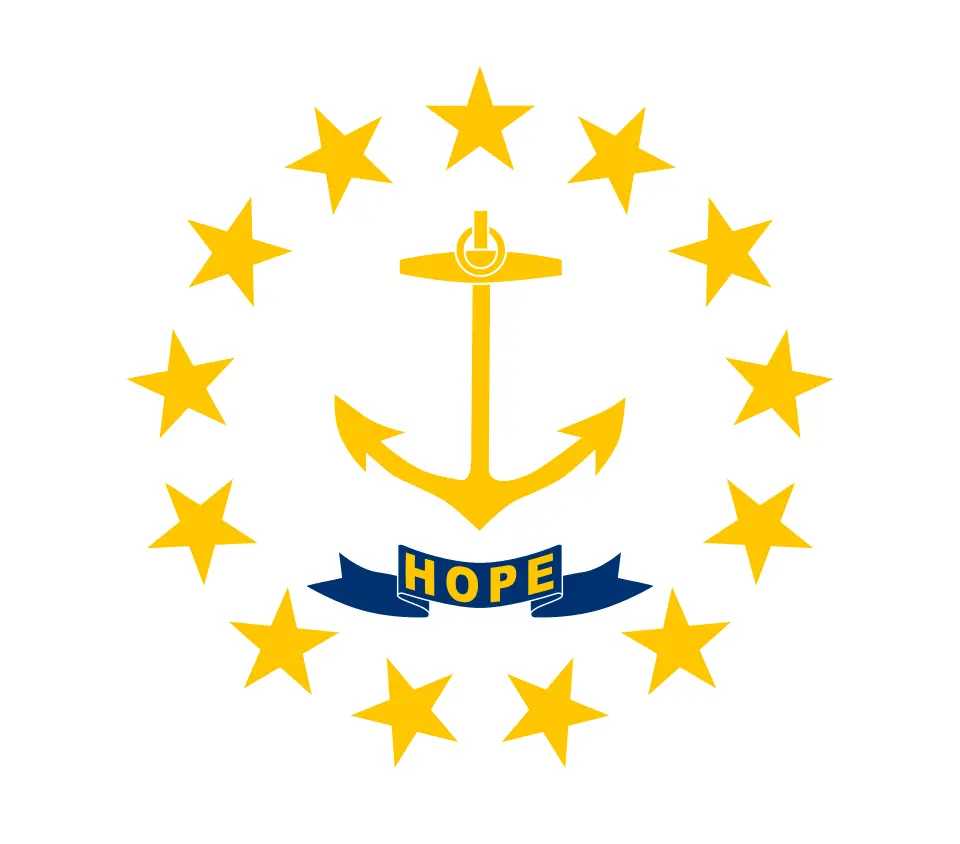
The state flag of Rhode Island is the official flag of the U.S. state of Rhode Island, consisting of a white background and a gold anchor in the center (a symbol for hope) surrounded by thirteen gold stars, for the original Thirteen Colonies and Rhode Island's status as the 13th state to ratify the Constitution. A blue ribbon below the anchor bears the state's motto in gold: "HOPE". The flag is frequently depicted with golden fringe around the edges of the flag, although the fringe is never actually on the flag unless it is used in federal-level displays, much like the national flag.
As early as the 1640s, the anchor and "hope" were found on the Rhode Island seal, and the seal's words and emblems were likely inspired by the biblical phrase "hope we have as an anchor of the soul," found in Hebrews 6:18-19. Rhode Island's earliest colonists were fleeing persecution in Massachusetts due to their religious beliefs.
Mercy Brown Vampire Incident

The Mercy Brown vampire incident occurred in Rhode Island in January 1892. It is one of the best documented cases of the exhumation of a corpse in order to perform rituals to banish an undead manifestation. The incident was part of the wider New England vampire panic.
Several cases of consumption (tuberculosis) occurred in the family of George Thomas (April 1, 1842 – November 17, 1922) and Mary Eliza "Elizabeth" Arnold Brown (October 11, 1847 – December 8, 1883) in Exeter, Rhode Island. Friends and neighbors believed that this was due to the influence of the undead.
Roger Williams

Roger Williams (c. 1603 – March 1683) was an English-born New England minister, theologian, author, and founder of the Providence Plantations, which became the Colony of Rhode Island and Providence Plantations and later the State of Rhode Island. He was a staunch advocate for religious liberty, separation of church and state, and fair dealings with the Native Americans.
Initially a Puritan minister, his beliefs evolved and he questioned the authority of the Puritan church in enforcing religious conformity. He was expelled by the Puritan leaders from the Massachusetts Bay Colony, and he established Providence Plantations in 1636 as a refuge offering what he termed "liberty of conscience" making Rhode Island the first government in the Western world to guarantee religious freedom in its founding charter. His ideas on religious tolerance and civil government directly influenced the principles later enshrined in the First Amendment of the U.S. Constitution. He briefly became a Baptist, and in 1638 he founded the First Baptist Church in America in Providence.
He then moved beyond organized religion, becoming a "seeker" who did not identify with any specific church. Williams studied the language of the New England Native Americans and published the first book-length study of it in English.
Today, Williams's legacy continues to shape debates on religious liberty and the role of government in matters of conscience, with his writings cited in legal arguments and Supreme Court decisions on the separation of church and state.
Gaspee Affair

The Gaspee affair was a significant event in the lead-up to the American Revolution. HMS Gaspee was a Royal Navy revenue schooner that enforced the Navigation Acts around Newport, Rhode Island, in 1772. It ran aground in shallow water while chasing the packet boat Hannah on June 9 off Warwick, Rhode Island. That night a group of men led by Abraham Whipple and John Brown attacked, boarded, and burned the Gaspee to the waterline.
The event sharply increased tensions between American colonists and Crown officials, particularly given that it had followed the Boston Massacre in 1770. Crown officials in Rhode Island aimed to increase their control over the colony's legitimate trade and stamp out smuggling in order to increase their revenue from the colony.
Concomitantly, Rhode Islanders increasingly protested the Townshend Acts and other British policies that had interfered with the colony's traditional businesses, which primarily rested on involvement in the maritime trade.
Along with similar events in Narragansett Bay, the affair marked the first acts of violent uprising against Crown authority in British North America, preceding the Boston Tea Party by more than a year and moving the Thirteen Colonies as a whole toward the coming war for independence.
Narragansett Runestone

Geological and aerial photo studies have shown this large meta-sandstone boulder, with its curious inscription, ended up in the intertidal zone of Narragansett Bay just south of Pojac Point in North Kingstown, at 41°38.90 N and 71°24.48 W most probably as the result of erosion brought about by the fabled 1938 hurricane.
The earliest known eyewitness accounts of the inscription dates from 1948, at which time neighborhood children began calling it Indian Rock due to the characters inscribed upon it. This rock, as it was submerged for the majority of daily tidal cycles, was known only to the locals until l984 when a quahogger, working from his skiff, noticed the inscription.
He notified researchers interested in Norse runic inscriptions in North America, setting the stage for the numerous attempts at an explanation ever since. Some believe it is a record of a visit to Narragansett Bay by the Vikings or other Norsemen, or Icelandic explorers/trappers, still others a voyage by the Knights Templar. Some believe it was more likely rendered by immigrants to our area, out of national pride, in the 19th-20th centuries.
The Stone disappeared in 2012. It was recovered by the Criminal Investigation Unit of the Rhode Island Department of Environmental Management in 2013 and was installed here in Wickford in 2015. Although no one can say with complete certainty exactly by whom or when these intriguing Runic symbols were carved into this stone, it is safe to say, as quoted from Professor Henrik Williams of Uppsala University in Sweden, the rune stone is “of considerable cultural significance to Rhode Island and New England, not the least because of the controversy, mystery, and even intrigue connected with it.”
Nine Men's Misery

Nine Men's Misery Cemetery is a historic cemetery in Cumberland, Rhode Island, marking the traditional mass grave of nine colonial soldiers said to have been captured and killed by Indigenous combatants in March 1676 during King Philip's War. The site is often described as one of the earliest colonial veterans' memorials in the United States.
Located within Monastery Park and registered as Rhode Island Historical Cemetery CU012, the cemetery was formally dedicated in 1928. Recent national attention has highlighted the ghostlore associated with the site.
Sprague Mansion

Former home of politically and financially prominent Sprague family. Birthplace of two Rhode Island governors and current headquarters of Cranston Historical Society.Birthplace of the Cranston Print Works and the place where Rhode Island Judicial history was changed by the murder of Amasa Sprague in 1843. William Sprague IV was also one of Abraham Lincoln's most important Civil War Governors.
Providence Athenaeum

The Providence Athenæum is an independent, member-supported library located on Providence’s historic Benefit Street.
Over its nearly 200 years of existence, the library has welcomed illustrious writers, spirited thinkers, and engaged community members through its doors to read, learn, gather, and debate. Our mission is to enrich the mind, inspire the spirit, and elevate the public discourse.
The Athenæum was founded in 1836, and predates the establishment of public libraries.
Awful Awful

Why call a drink the Awful Awful, let alone pay to own the name? According to the origin story, a fan once described the 24-ounce beverage as “awful big and awful good.” In hindsight, however, one could also make a case for the name as a result of the drink’s ties to multiple bankruptcies.
Newport Creamery, based in Rhode Island, and Friendly’s, which began in Massachusetts, both distributed the “Awful Awful” in the 1950s. But it was Bond’s Ice Cream of New Jersey that invented the frosty prototype, which blends flavored syrup and “ice milk” (which, according to some recipes, is just an unspecific flavor of ice cream and milk), then trademarked the name in 1948. Bond issued a license to Friendly’s (then known as “Friendly”) and Newport Creamery to use the title, but only outside of New Jersey. Should either business expand into Bond’s territory, they’d need to pick a new name.
In the 1960s, Friendly’s did exactly that. Customers entered ideas and “Fribble” won. Each of the three participants who suggested the word, which means “a frivolous person, thing, or idea,” won $100. Had Friendly’s waited until the following decade to expand, the contest would’ve proven unnecessary. Bond’s Ice Cream went bankrupt in the 1970s, and Newport Creamery leapt on the “Awful Awful” trademark, which cost them $1,000.
Fribbles and Awful Awfuls were once the same drink that existed under different names. Today, they’re different recipes. Newport Creamery’s twelve locations (ten in Rhode Island and two in Massachusetts) stick to the original composition, offering flavors such as chocolate, Oreo, coffee, bubblegum, strawberry, and mocha. Friendly’s has changed their formula multiple times, but offers Fribbles made with any of their ice cream flavors. The business, which was started by two brothers selling double-scoops for a nickel in 1935, went bankrupt in 2011. Friendly’s now has about 174 restaurants, down from 360 in 2013.
Ida Lewis

Ida Lewis was born in Newport, Rhode Island, the second oldest of four children of Captain Hosea Lewis of the Revenue-Marine. Her father was transferred to the Lighthouse Service and appointed keeper of Lime Rock Light on the small near-island Lime Rock in Newport in 1854, taking his family to live on the rock in 1857.After the family had been at Lime Rock for less than four months, he suffered a stroke and became disabled. Ida Lewis expanded her domestic duties to include caring for him and a seriously ill sister and also, with her mother's assistance, tending the light: filling the lamp with oil at sundown and again at midnight, trimming the wick, polishing carbon off the reflectors, and extinguishing the light at dawn.
Since Lime Rock was almost completely surrounded by water, the only way to reach the mainland was by boat. By age 15, Lewis had become known as the best swimmer in Newport. She rowed her younger siblings to school every weekday and fetched supplies from town as they were needed. She became very skillful at handling her heavy rowboat. Responding to criticism that it was un-ladylike for women to row boats, Lewis said that "None – but a donkey, would consider it 'un-feminine', to save lives."
Lewis and her mother tended the Lime Rock Light for her father from 1857 until 1873 when he died. Her mother was then appointed keeper, although Ida continued to do the keeper's work. By 1877 her mother's health was failing, leaving Ida with increased housekeeping and care-giving responsibilities. Her mother eventually died of cancer in 1878. Ida finally received the official appointment as keeper in 1879, largely through the efforts of an admirer, General Ambrose Everett Burnside, a Civil War hero who became a Rhode Island governor and United States senator. With a salary of $750 per year, Lewis was for a time the highest-paid lighthouse keeper in the nation. The extra pay was given "in consideration of the remarkable services of Mrs. Wilson in the saving of lives."
Comments