


The Thirteen Colonies: Maryland


Welcome to Series 8, all about the history and folklore of The Thirteen Colonies of America! Each week, we'll be exploring each colony in order of establishment. For our fourth episode, we talked about the fourth colony - Maryland!
Where is Maryland?
Below is a map showing Maryland in 1721. It looks a little different to the state today!

Flag and Motto of Maryland

The flag of Maryland is the official flag of the U.S. state of Maryland and the 17th-century heraldic banner of arms of Cecil, 2nd Baron Baltimore. It consists of the arms of his father George, 1st Baron Baltimore (1579–1632), quartered with those of his grandmother, heiress of the Crossland family. The flag was officially adopted by the Maryland General Assembly in 1904.
The banner of arms of the Barons Baltimore, now the Maryland state flag, contains the coat of arms of George Calvert, 1st Baron Baltimore in the canton (1st quarter) and the lower fly (4th quarter), while the arms of Alicia Crossland appear in the upper fly and lower hoist (2nd and 3rd quarters).
The arms of George Calvert, a former Secretary of State, were originally granted as a reward for storming a fortification in battle, with the vertical bars symbolzing the palisade.) Because George Calvert's mother was a heraldic heiress, he was entitled to use her Crossland family coat of arms in his own arms. Upon the death of George, 1st Baron Baltimore, in April 1632, the right to bear the arms and banner passed to his eldest son and heir Cecil Calvert, 2nd Baron Baltimore (1605–1675), to whom the Province of Maryland was granted that same year by King Charles I. Hence the use of his banner of arms as the flag.
The state motto, Fatti maschii, parole femine, has its origin in the archaic Italian. It literally translates as "Deeds are males, words are females",but Maryland's official translation has variously been "Deeds are manly, words are womanly" and "Manly deeds, womanly words." The current official translation, "Strong deeds, gentle words," was established during the 2017 legislative session. Maryland is the only state with a motto in Italian. The saying is the motto of the Calvert family (the Barons Baltimore), who first founded the Colony of Maryland. George Calvert, 1st Baron Baltimore (1579–1632), made it his family's motto in 1622 and it appears that the saying was well known in 17th-century England.
Harriet Tubman

Harriet Tubman (born Araminta Ross, c. March 1822 – March 10, 1913) was an American abolitionist and social activist. After escaping slavery, Tubman made some 13 missions to rescue approximately 70 enslaved people, including her family and friends, using the network of antislavery activists and safe houses known collectively as the Underground Railroad. During the American Civil War, she served as an armed scout and spy for the Union Army. In her later years, Tubman was an activist in the movement for women's suffrage.
Born into slavery in Dorchester County, Maryland, Tubman was beaten and whipped by enslavers as a child. Early in life, she suffered a traumatic head wound when an irate overseer threw a heavy metal weight, intending to hit another slave, but hit her instead. The injury caused dizziness, pain, and spells of hypersomnia, which occurred throughout her life. After her injury, Tubman began experiencing strange visions and vivid dreams, which she ascribed to premonitions from God. These experiences, combined with her Methodist upbringing, led her to become devoutly religious.
In 1849 Tubman escaped to Philadelphia, only to return to Maryland to rescue her family soon after. Slowly, one group at a time, she brought relatives with her out of the state, guiding dozens of other enslaved people to freedom. Tubman (or "Moses", as she was called) traveled by night and in extreme secrecy, and she later said she "never lost a passenger".After the Fugitive Slave Act of 1850 was passed, she helped guide escapees farther north into British North America (Canada) and helped newly freed people find work. Tubman met John Brown in 1858 and helped him plan and recruit supporters for his 1859 raid on Harpers Ferry.
When the Civil War began, Tubman worked for the Union Army, first as a cook and nurse and then as an armed scout and spy. For her guidance of the raid at Combahee Ferry, which liberated more than 700 enslaved people, she is widely credited as the first woman to lead an armed military operation in the United States. After the war, she retired to the family home on property she had purchased in 1859 in Auburn, New York, where she cared for her aging parents. She was active in the women's suffrage movement until illness overtook her and she was admitted to a home for elderly African Americans, which she had helped establish years earlier. Tubman is commonly viewed as an icon of courage and freedom.
Black-Eyed Susan

The Black-Eyed Susan (Rudbeckia hirta) has been the official Maryland flower since 1918 when it was designated the "Floral Emblem" of Maryland by the General Assembly (Chapter 458, Acts of 1918; Code General Provisions Article, sec. 7-306).
In his Species Plantarum (1753), the Swedish naturalist Carl Linnaeus (1701-1778) described and named the flower Rudbeckia after Olav Rudbeck and his son, both professors at the University of Uppsala, and hirta from the Latin meaning "rough hairy".
Baltimore Oriole

The female oriole's feathers are brownish-olive and dull orange, but the male's plumage is black and golden orange not unlike colors in the Calvert shield. This similarity led to its early association with the name of the Maryland proprietor. In 1698, "Baltemore Birds" were among the "Beasts of Curiosity" ordered sent from Maryland to grace the royal gardens (Archives of Maryland 23: 455-56). In 1894, Baltimore's major league baseball team was named after the bird.
Typically, the Baltimore Oriole in the spring migrates north from Mexico and South America to the United States, and returns south for the winter. In the spring, the Oriole weaves bag-shaped hanging nests often found on shade trees in small towns here and in the Midwest. Orioles feed on insects, fruit, and nectar, preferring ripe, dark-colored fruit, such as red cherries and purple grapes.
Maryland made special provisions to protect the Baltimore Oriole in 1882 (Chapter 154, Acts of 1882). Since passage of the Migratory Bird Treaty Act of 1918, the Baltimore Oriole is protected by federal law covering all migratory bird species, and, since 1975, by the State's Nongame and Endangered Species Conservation Act (Chapter 27, Acts of 1975).
Accokeek Creek

The Accokeek Creek archeological site (18PR8) is located in Southern Maryland along the banks of the Potomac River. This archeological site is among the most significant sites in the nation because of the impact its excavation had on our modern understanding of Native American societies in the Eastern Middle Atlantic.
The site is located within the boundaries of Piscataway Park, which is administered by National Capital Parks-East of the National Park Service. Situated approximately 25 miles downriver from Washington D.C., along Piscataway Creek, the Accokeek Creek site was home to the Potomac Valley’s indigenous inhabitants for thousands of years–dating as far back as 6,000 years ago and through the 1500s. Among the occupants were the Piscataway Indians of Southern Maryland whose ancestors still live nearby today.
The Accokeek Creek site was excavated in the 1930’s by Alice and Henry Ferguson who purchased land for their home in present-day Piscataway Park in the 1920’s. After excavating tens of thousands of artifacts, the Ferguson’s came to believe that they had rediscovered the site of “Moyaone,” the principal town of the Piscataway chiefdom visited by Captain John Smith in 1608. While the accuracy of the Fergusons’ claim is still disputed today, the excavations yielded a large collection of diagnostic artifacts that have helped form archeologist’s understanding of Native American history and culture in the region.
Based on analysis of stone projectile points found at the site, archeologists have determined that humans have intermittently called Accokeek Creek home for nearly 6,000 years. The site also contains four ossuaries that appear to have been in use between the 1300’s and European contact in the 1600s. The individuals buried in the ossuaries were interred with elaborate grave goods including copper adornments, shell beads, and clay pipes. These finds indicate that the area was occupied by politically complex chiefdoms by the 1500’s and was the home of the Piscataway chiefdom. The Accokeek Creek excavations indicate that potentially dozens of buildings stood at the site. These structures were enclosed by a series of protective palisades at the edge of the town, indicating that Accokeek Creek’s inhabitants were, at times, living in a violent world.
Archeologists believe that the predecessors of the Piscataway and other related peoples came to the Chesapeake Bay from the Appalachian Mountains sometime in the 1300’s bringing with them their Algonquian language and material culture. Based on ethnohistoric documents some archeologists and historians believe that the Piscataway group migrated instead from the area that became Maryland’s Eastern Shore in the 1300’s. Whatever the case, archeologists agree that the arrival of the Piscataway and other related people resulted in the creation of complex cultural traditions in the Potomac Valley.
In 1608, Captain John Smith visited Piscataway Creek on his voyage up the Potomac River and its tributaries. Smith’s 1612 map of the Chesapeake includes the town of “Moyaons” placed in the approximate location of Accokeek Creek. Map symbols indicate that the settlement was home to a werowance, a powerful Native American chieftain who controlled other groups within a geographical area. In 1634, a group of English colonists sailed up the Potomac and met with the leaders of the Piscataway nation at Moyaone. Their leader, Wannas, informed the colonists that the lands of Piscataway Creek were theirs and English settlement could not occur in the vicinity.
It is unknown if the archeological site of Accokeek Creek represents this 17th century village or an earlier settlement that the Piscataway nation relocated from. What is known however, is that the territory was a fundamentally important landscape for the Piscataway people from the time of European contact to the present day.By the 1690’s, Piscataway land in Prince George’s and Charles Counties had been confiscated by the English colonists and occupied by Maryland planters. Eventually, the Piscataway nation decided to move beyond the borders of the Maryland Colony and dispersed north and west.
While many Piscataway migrated outside of Maryland, others decided to stay, forming the ancestors of the current Piscataway inhabitants of the state. The diagnostic artifacts and archeological features present at the Accokeek Creek site have been used to develop and refine a cultural-history of the Mid-Atlantic region. Since its rediscovery in the 1930’s, Accokeek Creek has been one of the most important sites in the nation for understanding the Native American societies of the East Coast.
Colonial Annapolis Historic District

The Colonial Annapolis Historic District is a historic district in the City of Annapolis, the state capital of Maryland, that was designated a National Historic Landmark District in 1965 and was geographically further expanded in 1984.
Annapolis has served as the capital of both the Colony/Province and the State, along with being the county seat of Maryland's third county, Anne Arundel County, and is one of the first planned cities in colonial America. Many elements of the original town plan, developed in 1695 by Francis Nicholson, and about 120 of the 18th century buildings still remain. Along with its neighboring capital city to the south of Williamsburg of the Province/Colony of Virginia and the first years of the independent Commonwealth of Virginia, both towns serve as a "living microcosm" of the 1700s and early 1800s in the United States.
In terms of individually listed National Historic Landmarks and other sites on the National Register of Historic Places, the original historic colonial-era area includes the Maryland State House on State Circle, St. Ann's Church (Anglican/Episcopal) on neighboring adjacent Church Circle, and the historic residences, townhouses and some larger mansions of the town's wealthiest and most influential citizens of the Hammond-Harwood House and the Paca House and Gardens, the increase also includes the Artisan's House, Brice House, John Callahan House, and the Chase-Lloyd House.
Most of the downtown and harbor waterfront areas were declared a National Historic Landmark in 1965.
Moll Dyer

In the late 1600s, in what would become Leonardtown, Maryland, the townspeople were disturbed by the presence of a woman named Moll Dyer. She is believed to have been a healer who often aided the community, however, when an epidemic of influenza arose during the winter of 1697, the Town inhabitants looked to lay blame and named her as its cause.
Fearful of the sickness, a mob accused Dyer of witchcraft and set upon her. When they set fire to her small cabin on a bitterly cold night in February 1698, Dyer escaped into the surrounding woods. Days later, a young boy looking for lost livestock found her body with one hand frozen to a large rock and the other outstretched to the sky.
For many years, the famous rock’s location was unknown. But in 1968, writer Philip H. Love read about the legend and went in search of Moll Dyer’s rock. Love located the stone at the edge of a ravine and in the 1970s, it was moved to the Old Jail Museum in the town square of Leonardtown.
The legend says you can still see the imprint of her hands and knees on the rock on which they found her. The legend also says that Moll put a curse on the land and on the rock. It's rumored that anyone who touches the rock may become dizzy or even fall ill.
Black Aggie
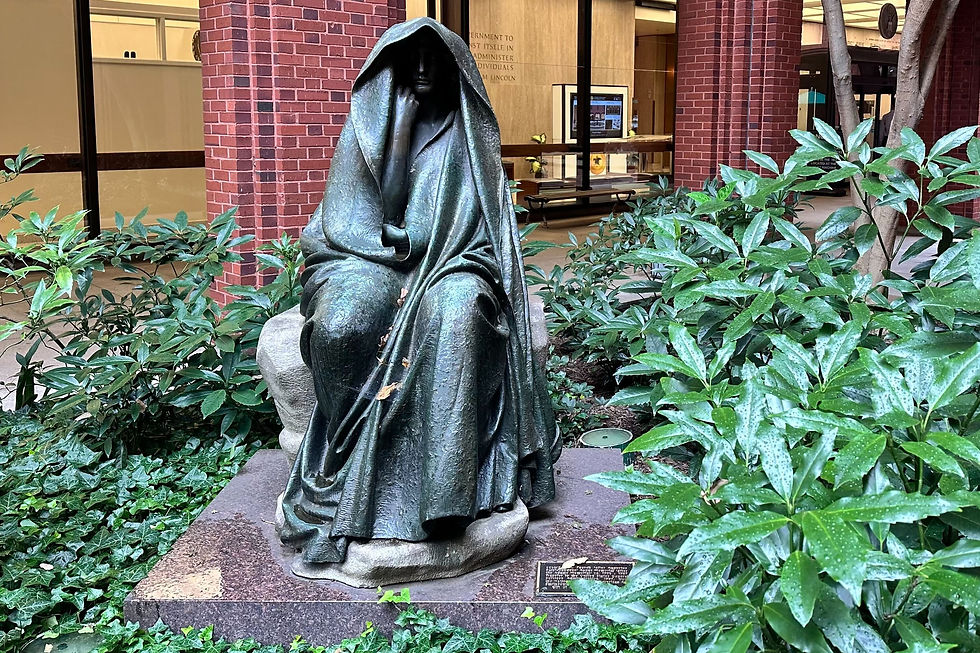
Black Aggie is the folkloric name given to a statue formerly placed on the grave of General Felix Agnus in Druid Ridge Cemetery in Pikesville, Maryland, United States. It is an unauthorized replica – rendered by Edward Ludwig Albert Pausch – of sculptor Augustus Saint-Gaudens' 1891 allegorical figure, popularly called “Grief”, at the Adams Memorial in Rock Creek Cemetery in Washington, D.C. The statue is of a somber seated figure in a cowl or shroud.
Beginning with its installation in 1926, the replica was surrounded by many urban legends, principally that someone spending a night in its lap would be haunted by the ghosts of those buried there; that the spirits of individuals buried at Druid Ridge would annually convene at the statue; that no grass would grow on the ground where the statue's shadow would lie during the daytime; or that the statue would animate itself during the night, whether by physically moving or by showing glowing red eyes.
These legends led to much unwelcome attention toward the statue; many people were caught breaking into the cemetery at night to visit it, and the pedestal was frequently vandalized. The Agnus family, disturbed by the attention the statue received, donated it to the Smithsonian in 1967. It sat for many years in storage at the National Museum of American Art (later named the Smithsonian American Art Museum) where an authorized recasting of the original Adams Memorial statue now sits.
Black Aggie was moved from her previous home at the museum to a courtyard behind the Dolley Madison House on Lafayette Square in Washington, where she currently stands. The bare, blank pedestal remains at the statue's former home at Druid Ridge Cemetery
Paw Paw Tunnel

The Paw Paw Tunnel is one of the most significant engineering features on the Canal. To save building six miles of canal along the river, the C&O Canal Company decided to construct a tunnel through a steep topographic ridge now called Tunnel Hill. When work began on the tunnel in 1836, the builders estimated the project would be completed within two years. The tunnel ultimately required 14 years to complete due to labor issues and violence, funding shortfalls, work stoppages, and the challenges of digging a 3,118-foot tunnel through the hard, loose shale. The tunnel opened in October 1850 with rockslides continuing to be a challenge throughout the tunnel’s history.
Today, when you plan your visit to the Paw Paw Tunnel, bring a flashlight and discover the weep holes, rope burns, rub rails, as well as brass plates marking every 100-feet that bring the tunnel’s history to life. Following your travels through the tunnel, enjoy the two-mile long Tunnel Hill Trail where you can discover breathtaking views of the Paw Paw Bends.
Middleton Tavern

The Middleton Tavern was established in 1750 by Horatio Middleton. It initially operated as an inn for seafaring men. After Horatio's death, his son, Manuel, ran the business. George Washington, Thomas Jefferson, Benjamin Franklin and members of the Continental Congress were known to frequent the tavern.
During the 1800s the family business included a general store and meat market. The Mandris family then bought the business and established a restaurant and a souvenir shop. Jerry Hardesty bought the property at 1968 and renamed the business into Middleton Tavern.
Local folklore suggests a ghost haunts the tavern, leaving a scent of cigar smoke on the upper balcony. Staff have given the entity the name "Roland" and some describe him as wearing Revolutionary-era clothing. Another local theory suggests the establishment is haunted by the ghost of George Schmidt, who was killed in front of the building in 1876. Today, the Tavern appears on a number of "ghost tours" of the Chesapeake Bay watershed region.
Snallygaster

It’s a great winged beast, with scales like a reptile and the wings and talons of a great bird. No. It’s half bird, half wildcat with yellow and black stripes. No. It’s a sable-eyed muskrat with a tuxedo front.
It’s the Snallygaster, and for several years in the late 1920s and early 1930s it caused a sensation in Frederick County, Maryland. Area settlers had told stories already for hundreds of years of a beast that stole chickens and other small farm animals and was generally viewed as a pest by farmers in the region. Many would paint symbols – called “hex signs” – on their barns in the hopes of warding off the monster.
The name “Snallygaster” is actually a mispronunciation of the term Schnellegeister – which is, itself, a corruption of the German term “schnelle geist,” or “quick spirit.” In Pennsylvania Dutch traditions, a “quick spirit” is responsible mostly for things like sudden drafts knocking over lightweight household objects or scattering papers.
For generations, the story didn’t change. No one ever saw the Snallygaster, but everyone assumed it was there. The monster’s reappearance coincided with Prohibition. Moonshiners in the forests and mountains of northern Maryland co-opted the old story in an effort to scare revenue agents away and to explain the sounds (like explosions and bending metal) that came from their stills at night.
Accounts of thunderous explosions and loud screeching sounds began circulating with disturbing regularity. As the noises became more common, so did reports of a winged creature – this time with huge tentacles – that would swoop down and snatch grown men up and drag them off into the night. If bodies were found, they were said to be drained of blood and scorched.
A local paper, The Middletown Valley Register, got on the case. Publishing detailed reports of the sightings, they painted a grim picture of the dangerous mountain regions of the area. It was decided that this new monster was the offspring of an egg that had been reported a generation prior.
Other papers jumped in on the act. The Baltimore Sun published articles, as did the Washington Post. As scrutiny increased, more pressure came to catch or photograph the Snallygaster. Supposedly, National Geographic was preparing an expedition to capture it on film. Trying to avert a panic, the Baltimore Sun reported the Snallygaster’s death in November 1932.
Michael Zittle, the Wizard of South Mountain

Michael Zittle Jr. (German: Michael Zittel) (October 5, 1798 – July 5, 1877) or The Wizard of South Mountain was an American occultist, ceremonial magician, author, and mountaineer. He was born to a German father, American mother, and was one of nine children. Zittle became popular in the area as healer, he would offer his services to alleviate a wide array of difficulties, such as compelling a thief to return stolen property, providing a “sure cure for fever," closing a wound from firearms, curing the bite of a mad dog and “dispelling the fear of the darkness of night.
A Friend in Need; Or, Secret Science was a handbook written by Zittle in 1845 on how to perform magic spells. It was based on a German book of magic, referred to by Zittle's neighbors as his "black book" or "conjuring book". According to legend, after publication of the book, Zittle lost his powers as a result of trying to commodify his supernatural powers. In 1975, a copy of the published English book was found by Boonsboro resident Pauline Routzahn. Today, a copy of both the English and original German can be viewed at the Boonsbourough Museum of History.
Clara Barton
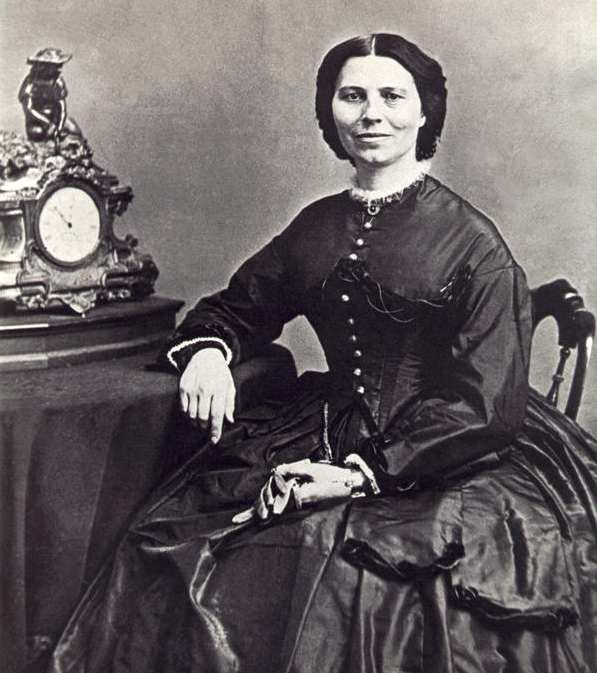
Clarissa Harlowe Barton (December 25, 1821 – April 12, 1912) was an American nurse who founded the American Red Cross. She was a hospital nurse in the American Civil War, a teacher, and a patent clerk. Since nursing education was not very formalized, and she did not attend nursing school, she provided self-taught nursing care. Barton is noteworthy for doing humanitarian work and civil rights advocacy at a time before women had the right to vote. She was inducted into the National Women's Hall of Fame in 1973.
Comments