


The Thirteen Colonies: New Hampshire


Welcome to Series 8, all about the history and folklore of The Thirteen Colonies of America! Each week, we'll be exploring each colony in order of establishment. For our third episode, we talked about New Hampshire, established in 1623 on land inhabited by the Algonquian-speaking Abenaki tribes.
Where is New Hampshire?
Below is a map showing the Province of New Hampshire betwwen 1691 and 1775, which looks a little different to the state today! At certain points, the Province also included Vermont and parts of New York too.

Flag and Motto of New Hampshire
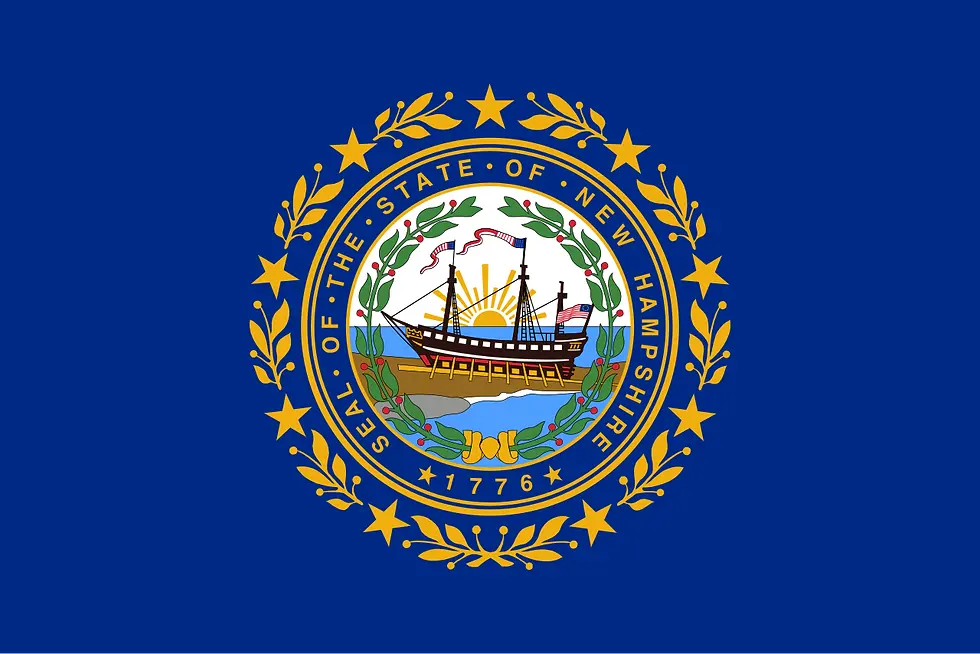
The seal of New Hampshire, codified by law in 1931, features the frigate USS Raleigh, encircled by a laurel wreath and nine stars. A granite boulder appears in the foreground, while water represents the harbor of Portsmouth.The U.S. state of New Hampshire has held two seals since it declared its independence from Great Britain on January 5, 1776.
The flag of New Hampshire, adopted in 1909, consists of the state seal centered on a blue field. It is currently unique among U.S. state flags for including the Stars and Stripes within the seal.
"Live Free or Die" is the official motto of the U.S. state of New Hampshire, adopted by the state in 1945. It is possibly the best-known of all state mottos, partly because it conveys an assertive independence historically found in American political philosophy and partly because of its contrast to the milder sentiments found in other state mottos.
The phrase was adopted from a toast written by General John Stark, New Hampshire's most famous soldier of the American Revolutionary War, on July 31, 1809. Poor health forced Stark to decline an invitation to an anniversary reunion of the Battle of Bennington. Instead, he sent his toast by letter:
Live free or die: Death is not the worst of evils.
By the time Stark wrote this, Vivre Libre ou Mourir ("Live free or die") was a popular motto of the French Revolution and was required as an oath of office for all legislators for the duration of the Constitution of 1791. A possible source of such mottoes is Patrick Henry's famed March 23, 1775, speech to the House of Burgesses (the legislative body of the Virginia colony), which contained the following phrase: "Is life so dear, or peace so sweet, as to be purchased at the price of chains and slavery? Forbid it, Almighty God! I know not what course others may take; but as for me, give me liberty or give me death!" However, the existence of Henry’s phrase is not recorded until its publication in 1817, so whether it could have influenced these mottoes cannot be ascertained.
The motto was enacted at the same time as the New Hampshire state emblem, on which it appears.
Oceanborn Mary House

According to the story, a group of settlers were sailing to the New World from Ireland in 1720. En route, a girl was born to James and Elizabeth Fulton. After the child's birth, the ship was waylaid by pirates, and upon seeing the newborn, the pirate captain offered to let them all live if the Fultons named the child after his mother, Mary. They agreed, and he gave them a bolt of green silk for a wedding dress for the child.
Everyone has their own opinion on which parts of the story are true and which are yarns being spun. It often gets embellished further with ideas that the pirate was a famous one or that he himself married the girl. But Ocean-Born Mary certainly lived, to the age of 94, in fact. Her grave is located in a cemetery behind the town hall in Henniker, NH. She’s buried under her married name, Mary Wallace. In front of the grave is a metal plaque upon which can be found the name “Ocean-Born Mary.”
In 1917, a man named Louis Roy moved to Henniker, after asking around for a house with some history. He was directed to what had once been the house of Robert Wallace, one of Mary’s sons. He bought the house, and starting calling it the Ocean-Born Mary House, despite the fact that she had never lived there. He started filling it with antiques he claimed were Mary’s, offering tours, dressing his mother in period costumes, conjuring ghost stories, and claiming that pirate gold was buried on the property and selling shovels to tourists to go find it.
The house is still known as the Ocean-Born Mary House. It’s on Bear Road, just outside of town, and bears a marker that reads, “Homestead of Robert Wallace, also known as Ocean Born Mary House, 1784.”
The Old Man of the Mountain
from

The Old Man of the Mountain, also called the Great Stone Face and the Profile, was a series of five granite cliff ledges on Cannon Mountain in Franconia, New Hampshire, United States, that appeared to be the jagged profile of a human face when viewed from the north. The rock formation, 1,200 feet (370 m) above Profile Lake, was 40 feet (12 m) tall and 25 feet (7.6 m) wide.
The Old Man of the Mountain is called "Stone Face" by the Abenaki and is a symbol within their culture. It is also a symbol to the Mohawk people. The first written mention of the Old Man was in 1805. It became a landmark and a cultural icon for the state of New Hampshire, and has been featured as the Emblem of New Hampshire since 1945. It collapsed on May 3, 2003. After its collapse, residents considered replacing it with a replica, but the idea was ultimately rejected. It remains a visual icon on the state's license plates and in other places.
Paul Revere

Paul Revere was an American silversmith, military officer and industrialist who played a major role during the opening months of the American Revolutionary War in Massachusetts, engaging in a midnight ride in 1775 to alert nearby minutemen of the approach of British troops prior to the battles of Lexington and Concord.
Born in the North End of Boston, Revere eventually became a prosperous and prominent Bostonian, deriving his income from silversmithing and engraving. During the American Revolution, he was a strong supporter of the Patriot cause and joined the Sons of Liberty. His midnight ride transformed him into an American folk hero, being dramatized in Henry Wadsworth Longfellow's 1861 poem "Paul Revere's Ride". He also helped to organize an intelligence and alarm system to keep watch on the movements of British forces. Revere later served as an officer in the Massachusetts Militia, though his service ended after the Penobscot Expedition, one of the most disastrous American campaigns of the American Revolutionary War, for which he was absolved of blame.
Following the war, Revere returned to his silversmith trade. He used the profits from his expanding business to finance his work in iron casting, bronze bell and cannon casting, and the forging of copper bolts and spikes. In 1800, he became the first American to successfully roll copper into sheets for use as sheathing on naval vessels.
Wabanaki Confederacy
The Wabanaki Confederacy (Wabenaki, Wobanaki, translated to 'People of the Dawn' or 'Easterner'; also: Wabanakia, 'Dawnland') is a North American First Nations and Native American confederation of five principal Eastern Algonquian nations: the Abenaki, Mi'kmaq, Wolastoqiyik, Passamaquoddy (Peskotomuhkati), and Penobscot.
There were more tribes, along with many bands, that were once part of the Confederation. Native tribes such as the Nanrantsouak, Alemousiski, Pennacook, Sokoki, and Canibas, through massacres, tribal consolidation, and ethnic label shifting were absorbed into the five larger national identities.
Members of the Wabanaki Confederacy, the Wabanakiyak, are located in and named for the area which they call Wabanaki ("Dawnland"), roughly the area that became the French colony of Acadia. The territory boundaries encompass present-day Maine, New Hampshire, and Vermont, in the United States, and New Brunswick, mainland Nova Scotia, Cape Breton Island, Prince Edward Island and some of Quebec south of the St. Lawrence River, Anticosti, and Newfoundland in Canada.
Passaconaway

Passaconaway was a 17th century sachem and later bashaba (chief of chiefs) of the Pennacook people in what is now southern New Hampshire in the United States, who was famous for his dealings with Plymouth Colony and Massachusetts Bay Colony.
Passaconaway was widely respected by contemporaneous Native Americans in the New England region, by English colonists (even those who said that his supernatural abilities were satanic in origin), and was taken seriously as a political leader by colonial English settlers. One of the key native figures in the colonial history of Massachusetts, New Hampshire, and Maine, he is believed to have been born between 1550 and 1570, and had died by 1669 (his birth and death dates are imprecise, and reckoning is skewed by the claim of one reporter, who says that he met Passaconaway when the latter was 120 years old).
He was a powerful and widely respected powow (a ritual expert and mediator between humans and spirits similar to a shaman); English accounts note that he was allegedly able to make water burn, produce ice in the summer, make trees dance, call up thunderstorms, make dried leaves turn green, and make living snakes out of dead snake skin. Prior to, and during the early period of, colonial encroachment Passaconaway presumably followed traditional New England Native lifeways in the Pennacook territories around the Merrimack River, moving among established village sites like Amoskeag and Pawtucket seasonally, which accounts for his historical association with several places in New Hampshire and Massachusetts. Colonial records specify that Passaconaway lived at the top of the Pawtucket Falls (today's Lowell, Massachusetts). Local New Hampshire history says that he lived and moved seasonally among various fishing and planting spots along the Merrimack River, including the Amoskeag Falls in present-day Manchester, several fertile islands, present-day Horseshoe Pond, and sites along the nearby coast.
Lake Winnipesaukee

Lake Winnipesaukee is a classic glacially formed oligotrophic (this means low fertility) lake. The water is quite clear; average main lake and bay visibility is 27-29 feet. Visibility is slightly less in central portions of Moultonborough Bay (21 feet) and less still in the extreme northern end of this bay (less than 15 feet).
The physical nature of the main-lake shoreline ranges from boulder-strewn to sandy. Some back-bay areas (e.g. the extreme northern end of Moultonborough Bay) have wetland shorelines, but this habitat is limited overall. The lake bottom and reefs/shoals are predominantly ledge, boulders, cobble, gravel, and sand, with softer muck bottoms in basin and back-bay areas.
Emergent and submergent vegetation are sparsely located throughout the lake. Submergents include pondweed, variable milfoil, bladderwort, quillwort, and pipewort; emergents include yellow and white water lily, pickerelweed, and water shield. The greatest concentrations of these aquatics are found in the northern end of Moultonborough Bay.
The lake is also said to be the home of 'Winnie', a water monster!
Agiocochook - Crystal Hill - Mount Washington

Mount Washington (Abenaki: Agiocochook) is an ultra-prominent mountain in the state of New Hampshire. It is the highest peak in the Northeastern United States at 6,288.2 ft (1,916.6 m) and the most topographically prominent mountain east of the Mississippi River.
The mountain is notorious for its erratic weather. On the afternoon of April 12, 1934, the Mount Washington Observatory recorded a windspeed of 231 mph (372 km/h) at the summit, the world record from 1934 until 1996. Mount Washington still holds the record for the highest measured wind speed not associated with a tornado or tropical cyclone.
The mountain is located in the Presidential Range of the White Mountains, in Coös County, New Hampshire. The mountain is in several unincorporated townships, with the summit in the township of Sargent's Purchase. While nearly the whole mountain is in the White Mountain National Forest, an area of 60.3 acres (24.4 ha) surrounding and including the summit is designated as Mount Washington State Park.
America's Stonehenge

America's Stonehenge is a historic site and museum that preserves more than 4,000 years of human history, in Salem, New Hampshire. From the age of ancient construction to Pawtucket occupation, the colonial period, the Pattee era, and later archaeological research, many people and cultures have lived and worked on this site. Their stories are captured in the artifacts, structures, and landscapes that they left behind.
Barney and Betty Hill Incident

The Hills were a respectable, middle-class couple who lived in Portsmouth, New Hampshire. Barney worked for several years at the South Boston Postal Annex before transferring to Portsmouth and was an active member of the New Hampshire NAACP. Betty was a social worker for the New Hampshire Health and Welfare Department and active in the Unitarian Church. Their friends, colleagues, and neighbors all described them as “good, wholesome people.” (Luttrell, October 25, 1965, 24) The only thing seemingly remarkable about the pair was that they were an interracial couple at the height of the Civil Rights Movement.
That is, until 1961, when the Hills were returning home from a road trip through Canada. On September 19, the couple, along with their dachshund Delsey, encountered a strange aircraft on U.S. Route 3, near Franconia. What they saw that night left the couple shaken and confused. Months after the trip, Betty and Barney struggled with unexplained anxiety, nightmares, and health issues. Strangest of all, neither could recall what occurred in the moments after they spotted the aircraft. Two hours of their trip seemed like a blank page in their memory. This led the Hills to consult with Air Force officials, scientists, and eventually a psychiatrist who specialized in hypnosis therapy, all to uncover what really happened during those lost hours.
Beach Plums

Prunus maritima, the beach plum, is a species of plum native to the East Coast of the United States. It is grown commercially for its fruit and resists certain pests.
The species can be found from Maine south to Maryland. Although sometimes listed as extending north to Canada's New Brunswick, the species is not known from collections there and does not appear in the most authoritative works on the flora of that province.
The plant is salt tolerant and cold hardy. It prefers the full sun and well-drained soil. It spreads roots by putting out suckers but in coarse soil puts down a taproot. In dunes it is often partly buried in drifting sand.
General John Stark

John Stark (August 28, 1728 – May 8, 1822) was an American military officer who served during the French and Indian War and the Revolutionary War. A major general, he became known as the "Hero of Bennington" for his exemplary service at the Battle of Bennington in 1777.
John Stark was born in Londonderry, New Hampshire (at a site that is now in Derry) in 1728. His father, Archibald Stark (1693–1758) was born in Glasgow, Scotland, to parents who were from Wiltshire, England; Stark's father met his future wife when he moved to Londonderry in Ireland. When Stark was eight years old, his family moved to Derryfield (now Manchester, New Hampshire), where he lived for the rest of his life. Stark married Elizabeth "Molly" Page, with whom he had 11 children including eldest son Major Caleb Stark and son Lieutenant Archibald Stark, who both served in the military.
On April 28, 1752, while on a hunting and trapping trip along the Baker River, a tributary of the Pemigewasset River, he was captured by Abenaki warriors and brought back to Canada but not before warning his brother William to paddle away in his canoe, though neighbor David Stinson was killed. While a prisoner of the Abenaki, he and his fellow prisoner Amos Eastman were made to run a gauntlet of warriors armed with sticks.
Stark grabbed the stick from the first warrior's hands and proceeded to attack him, taking the rest of the warriors by surprise. The chief was so impressed by this heroic act that Stark was adopted into the tribe, where he spent the winter.
The following spring a government agent sent from the Province of Massachusetts Bay to work on the exchange of prisoners paid his ransom of $103 Spanish dollars and $60 for Amos Eastman. Stark and Eastman then returned to New Hampshire safely.
Daniel Webster

Daniel Webster (January 18, 1782 – October 24, 1852) was an American lawyer, statesman, and diplomat who represented New Hampshire and Massachusetts in the U.S. Congress and served as the 14th and 19th U.S. secretary of state under presidents William Henry Harrison, John Tyler, and Millard Fillmore. Webster was one of the most prominent American lawyers of the 19th century, arguing over 200 cases before the United States Supreme Court in his career. During his life, Webster had been a member of the Federalist Party, the National Republican Party, and the Whig Party. He was among the three members of the Great Triumvirate along with Henry Clay and John C. Calhoun.
Born in Salisbury, New Hampshire, in 1782, Webster established a successful legal practice in Portsmouth, New Hampshire, after graduating from Dartmouth College and serving a legal apprenticeship. A prominent opponent of the War of 1812, he won election to the United States House of Representatives, where he served as a leader of the Federalist Party. Webster left office after two terms and moved to Boston, Massachusetts. He became a leading attorney before the U.S. Supreme Court, winning cases such as Dartmouth College v. Woodward, McCulloch v. Maryland, and Gibbons v. Ogden.

Comments