


The Thirteen Colonies: Connecticut


Welcome to Series 8, all about the history and folklore of The Thirteen Colonies of America! Each week, we'll be exploring each colony in order of establishment. For our fifth episode we talked all about Connecticut!
Where is Connecticut?

Flag and Motto of Connecticut

The flag of the U.S. state of Connecticut is a white baroque shield with three grapevines, each bearing three bunches of purple grapes on a field of royal blue. The banner below the shield reads "Qui Transtulit Sustinet," Latin for "He who transplanted sustains," Connecticut's state motto.
The design comes from the seal of Saybrook Colony, designed by George Fenwick when it was established in 1639. That seal depicted 15 grapevines and a hand in the upper left corner with a scroll reading "Sustinet qui transtulit." When the Connecticut Colony bought Saybrook in 1644, the seal transferred to the Connecticut Colony. On October 25, 1711, the governor and legislature changed the seal. They reduced the number of grapevines from 15 to three, to represent the three oldest settlements (Windsor, Wethersfield, and Hartford) (or possibly the three separate settlements, Connecticut Colony, Saybrook Colony, and New Haven Colony, which had been absorbed into Connecticut by that time) and rearranged the wording and position of the motto.
Mountain Laurel

Kalmia latifolia, the mountain laurel, calico-bush, or spoonwood, is a flowering plant and one of the 10 species in the genus of Kalmia belonging to the heath(er) family Ericaceae. It is native to the eastern United States. Its range stretches from southern Maine to northern Florida, and west to Indiana and Louisiana. Mountain laurel is the state flower of Connecticut and Pennsylvania. It is the namesake of Laurel County in Kentucky, the city of Laurel, Mississippi, Mount Laurel, New Jersey, and the Laurel Highlands in southwestern Pennsylvania
Nathan Hale

Nathan Hale (June 6, 1755 – September 22, 1776) was an American Patriot, soldier, and spy for the Continental Army during the American Revolutionary War. He volunteered for an intelligence-gathering mission in New York City but was captured by the British and executed. Hale is considered an American hero and in 1985 was officially designated the state hero of Connecticut.
The Charter Oak

The Charter Oak was an exceptionally large white oak tree growing on Wyllys Hill in Hartford, Connecticut, from around the 12th or 13th century until it fell during a storm in 1856. Connecticut colonists hid Connecticut's Royal Charter of 1662 within the tree's hollow to thwart its confiscation by Sir Edmund Andros. The oak was viewed as a symbol of American independence and was commemorated on the Connecticut State Quarter. It was also depicted on a commemorative half dollar and a postage stamp for Connecticut's tercentennial in 1935.
The oak was blown down by a violent, tempestuous storm on August 21, 1856, and its timber was used to make many chairs now displayed in the Hartford Capitol Building. The desk of the Governor of Connecticut and the chairs for the Speaker of the House of Representatives and President of the Senate in the state capitol were made from wood salvaged from the Charter Oak. Another chair was made by noted painter Frederic Church, a native of Hartford, and is still on display at his former home.
The Windham Frog Fright

The Battle of the Frogs was a frog-related incident in the Connecticut Colony town of Windham in 1754.
On a summer night in June or July, the people of Windham were awakened by a mysterious loud noise whose source they could not identify. The French and Indian War had recently broken out and, fearing an attack, a scouting party was sent out to investigate. By the morning, it was discovered that the sound was American bullfrogs, hundreds to thousands of which were found dead in a nearby mill pond.
News of Windham's embarrassing "battle" with the frogs spread throughout the colony and became a running joke in the region. Ballads and exaggerated accounts of the incident proliferated. The townspeople adopted the frog as a mascot of the community, creating a town seal with a frog and using frog vignettes on Windham Bank currency. The comic opera The Frogs of Windham was written about the Battle of the Frogs.
The Thread City Crossing in Willimantic is colloquially known as the "Frog Bridge" for the enormous copper frogs that perch at each corner.
Various theories for the behavior of the frogs have been raised. Some sources attest to a severe drought that summer and it has been speculated that the frogs fought among themselves for access to scarce water. Other explanations suggested that there had been an outbreak of disease or a lekking amongst the frogs.
Israel Putnam Wolf Den

Israel Putnam Wolf Den is a historic site off Wolf Den Road in Pomfret, Connecticut. At this location in 1742, Israel Putnam shot and killed Connecticut's last known wolf. The site was added to the National Register of Historic Places in 1985.
A version of the legend, documented in a 1788 biography by David Humphreys, holds that Putnam and others tracked a wolf to the cave after it had killed seventy sheep on Putnam's farm. Putnam entered the cave by torch light, shot the wolf, and was pulled from the cave by a rope tied to his ankles, dragging the wolf behind him.
The story has possibly been embellished over the years, but the main themes of the story, the cave and wolf, are believed to be factual by most Putnam biographers.The exploit was part of the early career of Putnam, who went on to become an officer in the French and Indian War, a leading Connecticut figure in the American Revolutionary War and a folk hero for many generations.
The cave, a natural fissure in an outcropping of grey gneiss ledge, runs for about 20 feet back into the rock. At one time it may have opened into a small chamber, but leaves, debris, and fill have erased any evidence of this. The cave looks much as it did in the late 18th century when the tale of Putnam and the wolf was codified.
Today, the Wolf Den is accessible from a hiking trail off of Wolf Den drive in Mashamoquet Brook State Park, a +1,000-acre (400 ha) Connecticut state park, with two campgrounds, hiking, fishing, swimming, and picnicking.
Pequot War
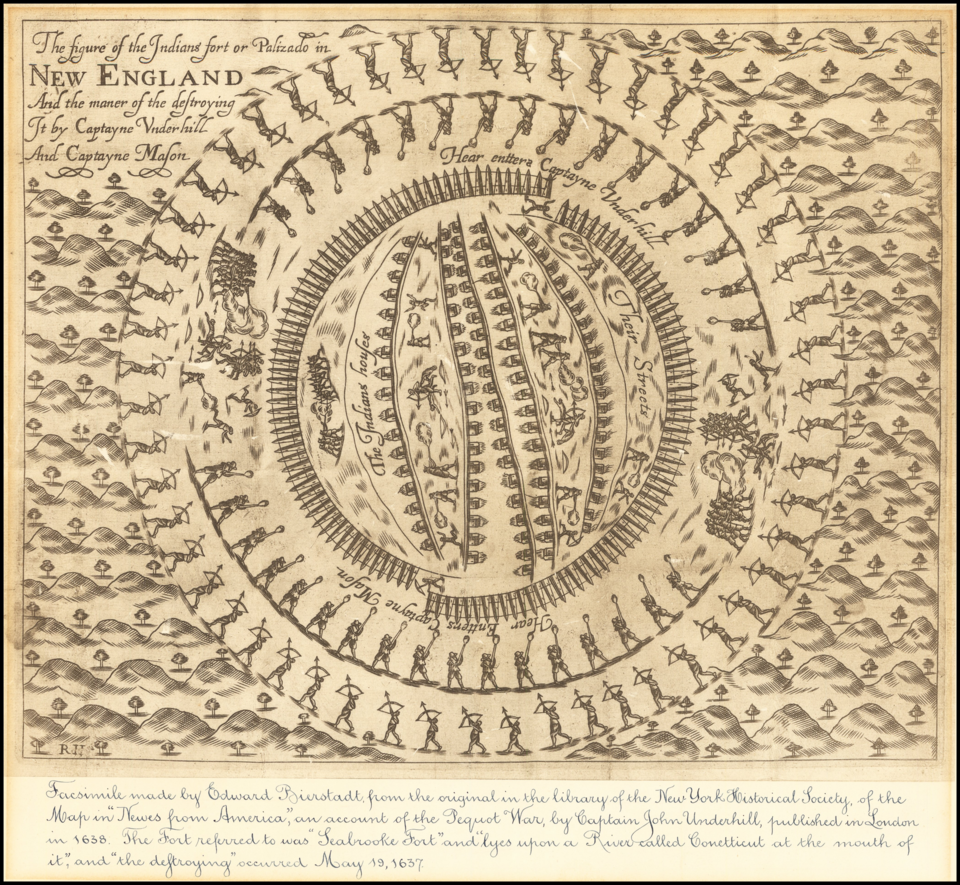
The Pequot War was a conflict that took place in 1636 and ended in 1638 in New England, between the Pequot nation and a joint effort of the English colonists from the Massachusetts Bay, Plymouth, and Saybrook colonies and their allies from the Narragansett and Mohegan nations. The war concluded with the decisive defeat of the Pequot. In an event called the Mystic massacre, English colonists of the Connecticut Colony and their allies set the village of Pequot Fort ablaze, blocked the exits, and shot anyone trying to escape. By the end of the war, about 700 Pequots had been killed or taken into captivity.
Hundreds of Pequot prisoners were enslaved. While some of the enslaved persons were kept in the colonies of the region, they were generally deemed unfit as slaves and less desirable than enslaved people of African origin. Because of this, most of the enslaved Pequots were eventually sold to colonists in Bermuda or the West Indies, while a minority of the original numbers remained in the region. Other survivors were dispersed as captives to the Narragansett and Mohegan nations.
The Treaty of Hartford of 1638 sought to eradicate the Pequot cultural identity by prohibiting the Pequots from returning to their lands, speaking their tribal language, or referring to themselves as Pequots. The result was the elimination of the Pequot nation as a viable polity in southern New England, and the English colonial authorities classified them as extinct. Survivors who remained in the area were absorbed into other local nations; however, a western band retained sovereignty in Connecticut and are today a Federally recognized tribal nation.
The Warrens

Edward Warren Miney (September 7, 1926 – August 23, 2006) and Lorraine Rita Warren (née Moran; January 31, 1927 – April 18, 2019) were American paranormal investigators and authors associated with prominent cases of alleged hauntings. Edward was a self-taught and self-professed demonologist, author, lecturer and artist. Lorraine professed to be clairvoyant and a light trance medium who worked closely with her husband.
In 1952, the Warrens founded the New England Society for Psychic Research (NESPR), the oldest ghost-hunting group in New England. They authored many books about the paranormal and about their private investigations into various reports of paranormal activity. They claimed to have investigated well over 10,000 cases during their career. The Warrens were among the first investigators in the Amityville haunting. According to the Warrens, the official website of the NESPR, Viviglam Magazine, and several other sources, the NESPR uses a variety of individuals, including medical doctors, researchers, police officers, nurses, college students, and members of the clergy in its investigations.
Stories of ghost hauntings popularized by the Warrens have been adapted as or indirectly inspired dozens of films, television series, and documentaries, including several films in the Amityville Horror series and the films in The Conjuring Universe.
Skeptics Perry DeAngelis and Steven Novella investigated the Warrens' evidence and called it "blarney". Skeptical investigators Joe Nickell and Benjamin Radford concluded that the better-known hauntings, Amityville and the Snedeker family haunting (dramatized in the film The Haunting in Connecticut), did not happen and had been invented.
Connie

Hidden within the undulating arm of the Connecticut River is a serpent that has frightened those who’ve lived on it banks since colonists first settled there. Often it has been described as an eel or snake-like serpent over one hundred feet long. Though over the past three hundred years it has been spotted by people across three states, it still appears to remain a mystery.
In the early 1800s, spotting strange creatures off the coast of Connecticut was not uncommon. Sailors would return to port with tales of ghastly leviathans they encountered in their travels. The most peculiar of these stories frequently surfaced in the local publications. One that crossed the pages of the New York Times and Scientific American was not reported by sailors at sea, but by people deep in the heart of Connecticut. This beast appeared to make its home in the Connecticut River.
Those still familiar with the creature have affectionately named it Connie. Some believe it might be lurking in the Hog River Tunnel, under Hartford, Connecticut. Others believe there is a population of these serpents off the shores of New England, and like the young Atlantic Sturgeon, remain in fresh water rivers for two to seven years. Either way, with the ever growing activity in and around the river, it shouldn’t be long before someone spots Connie or her descendents making another appearance.
The Griswold Inn

Independence was in the air, and on January 31st, 1776, the Colony of Connecticut authorized the building of its first warship for the Revolution, the Oliver Cromwell. Charged with this mission was shipbuilder Uriah Hayden of Essex (then known as “Saybrook”) who quickly hired tradesmen and contracted with suppliers to outfit the vessel. Essex, perfectly situated for shipbuilding, suddenly experienced an economic boom as the Hayden’s housed the shipyard workers, and provided food, spirits and lodging to the suppliers, politicians and other patriots who would visit: the Oliver Cromwell was successfully launched on June 13, 1776.
Born of Independence, these are the beginnings of The Griswold Inn, a destination for seafarers and land travelers alike for over 250 years. Today the “Gris” remains the center of a thriving community, offering a unique experience and a comfortable connection to the past.
Following the war, a vigorous economic climate and remarkable innovations forever changed the way Americans lived and traveled. Regular steamboat service began on the Connecticut River in 1824 with Essex as an important stop, and a new ferry crossing and turnpike also opened nearby. Suddenly the population was able to travel, by land and water, and the citizenry was hungry to satisfy their curiosity. The Griswold Inn was in the perfect location to capitalize on both the land and water traveler and offered a warm and comfortable refuge from a difficult passage or inclement weather. Steamboats were built ever larger and regular service between Hartford and New York included a stop in Essex. This “golden era” of steamboating is remembered well in The Griswold Inn’s outstanding collection of marine art and artifacts from the period. Prints by Currier & Ives and Endicott & Co., ship’s portraits by James Bard, Antonio Jacobsen, Charles Parsons and others, and illustrations by Samuel Ward Stanton and Norman Rockwell cover the walls. There is also an extensive collection of firearms primarily used during the War of 1812 and/or the Revolutionary War together with Connecticut weapons made by Samuel Colt and others.
The Griswold Inn was the site of protests during the 1840’s organized by the women of the “Temperance Movement”. Several temperance banners remain from those protests, now hanging in the historic dining section of the Inn. For a time, The Griswold Inn itself became a “first class temperance hotel”, although that doesn’t seem to have lasted for very long. Even as the nation was turning toward prohibition in the early 20th century, the “Gris” was known as a reliable source for spirits. Often raided, occasionally fined and always back in business, the Federal authorities seemed to have had their hands full trying to stop the flow of liquor up the Connecticut River by “rum runners” at all hours of the night. These fast boats would dock on one of the many secluded coves along the river, unload, and be gone before anyone could track them down. The “Feds” were no match for the independent Yankee seaman who grew up on these waters, not unlike their ancestors, the “privateers”.
The Great Depression, prohibition and the end of ship building all took its toll on Essex and the surrounding area. The economy sank and life slowed down but, despite these challenges, The Griswold Inn survived. It was the careful stewardship of the Ladd/Lovell family during this period that allowed the Inn to thrive again as Essex was discovered by a new force from the sea, the recreational yachtsman. By the 1940’s, sailors were once again sailing into Essex harbor, yacht clubs were established, and the unique charm of The Griswold Inn rediscovered as a destination. By the 1960s, pleasure craft were in abundance, I-95 had been completed and lots of weekend travelers from New York City and further found their way to Essex. The dining rooms of the “Gris” were expanded and the Lovell’s purchased adjacent historic properties to offer additional lodging.
This expansion continued when the “Gris” was sold to William Winterer in the 1970s with the addition of several buildings across Main Street.
The Paul Family of Essex purchased The Griswold Inn in 1995 and has passionately preserved the historic property. The Griswold Inn Wine Bar & Bistro was added in 2005 and The Griswold Inn Store, Goods & Curiosities, in 2010.
Prudence Crandall

Prudence Crandall (September 3, 1803 – January 27, 1890) was an American schoolteacher and activist. She ran the Canterbury Female Boarding School in Canterbury, Connecticut, which became the first known school for African American girls ("young Ladies and little Misses of color") in the United States led by a white woman. She was the sister of Reuben Crandall, the defendant in the Trial of Reuben Crandall.
In 1832, when Crandall admitted Sarah Harris, a 20-year-old African American woman, to her school, she created what can be considered the first known integrated classroom in the United States.Following the decision, parents of white students began to withdraw their daughters.
Rather than ask Sarah to leave, she decided that if white girls would not attend with the Black students, she would focus on educating African American girls to become teachers. She was arrested and spent a night in jail. Repeated trials for violating a Connecticut law, passed explicitly to make her work illegal, as well as violence from the townspeople, resulted in Crandall being unable to keep the school open safely. She left Connecticut and never lived there again.
Much later, the Connecticut legislature, with lobbying from Mark Twain, a resident of Hartford, passed a resolution honoring Crandall and providing her with a pension. She died a few years later, in 1890.
She was named the State Heroine of Connecticut by the Connecticut General Assembly in 1995.
Comments