


The Thirteen Colonies: Virginia


Welcome to Series 8, all about the history and folklore of The Thirteen Colonies of America! Each week, we'll be exploring each colony in order of establishment. For our first episode, we talked about Virginia. Established on land inhabited by Indigneous nations including the Powhatan as 'Jamestown' in 1607, it's still referred to as 'the Mother of States.'
Where is Virginia?
Below is a map showing the colony of Virginia, which looks a little different to Virginia today! Originally, West Virginia was part of the British Colony of Virginia, and subsequently the US Commonwealth of Virginia and State of Virginia, until West Virginia separated in 1863.

Wahunsenacawh

Powhatan (c. 1547 – c. 1618), whose proper name was Wahunsenacawh (alternately spelled Wahunsenacah, Wahunsunacock, or Wahunsonacock), was the Mamanatowick (leader) of the Powhatan Confederacy, a confederacy of Algonquian-speaking Native Americans living in Tsenacommacah, in the Tidewater region of Virginia at the time when English settlers landed at Jamestown in 1607.
Powhatan, alternately called "King" or "Chief" Powhatan by English settlers, led the main political and military power facing the early colonists, and was probably the older brother of Opechancanough, who led attacks against the settlers in 1622 and 1644. He was the father of Matoaka (Pocahontas).
Wahunsenacawh's Mantle

Powhatan’s Mantle is a large deer-hide hanging with shell beadwork decoration that dates to the first period of contact between Indigenous North American peoples and British colonists. It was probably made in the early 1600s in the southern Chesapeake Bay region of North America, by the Algonquian speaking peoples of the Powhatan Confederacy.
It is named for Wahunsenacawh (around 1550–1618), the powerful paramount chief of the Powhatan people, who was known to the English as ‘Chief Powhatan’. He is also known as the father of Pocahontas (Matoaka), the famed North American woman who married one of the English settlers, and visited England in 1616 –17.
The Mantle consists of four hides of white-tailed deer (Odocoileus virginianus) that have been trimmed and sewn together with sinew. The shell beadwork consists of a central standing human-like figure flanked symmetrically by two opposed four-legged animal figures in profile. One of these figures has claws, short ears and a long tail, and has been interpreted as a wolf. The other has hooves, larger ears and a shorter tail, and may be a white-tailed deer. The three figures are surrounded by thirty-four circles.
The meaning of the three central figures is unknown, although it is thought that the human figure might either represent a deity, or Powhatan as paramount chief. Researchers believe that the circles represent settlements, as they do on south-eastern Indigenous American maps of that time, and that they probably represent the tribal nations of the Powhatan Confederacy.
The mantle is unique with no known parallels. It is beautifully constructed, and the design executed with precision. It represents a major investment of artistic skill and labour, and must always have been prized.
The Mantle is first recorded as being in the Tradescant collection in London in July 1638, but exactly how they acquired it is not known. The most widely accepted explanation is that it may be one of the gifts presented by Powhatan in 1608 to Captain Newport for King James I.
Captain John Smith

John Smith (c. 1579 – 21 June 1631) was an English soldier, explorer, admiral of New England, and author. He was knighted for his services to Sigismund Báthory, Prince of Transylvania, and his friend Mózes Székely.
Following his return to England from a life as a soldier of fortune and as a slave,he played an important role in the establishment of the colony at Jamestown, Virginia, the first permanent English settlement in North America, in the early 17th century.
He was a leader of the Virginia Colony between September 1608 and August 1609, and he led an exploration along the rivers of Virginia and the Chesapeake Bay, during which he became the first English explorer to map the Chesapeake Bay area. Later, he explored and mapped the coast of New England.
Pocahontas

Pocahontas , born Amonute, also known as Matoaka and Rebecca Rolfe; c. 1596 – March 1617) was a Native American woman belonging to the Powhatan people, notable for her association with the colonial settlement at Jamestown, Virginia. She was the daughter of Wahunsenacawh, the Mamanatowick (leader) of a network of tributary tribes in the Tsenacommacah (known in English as the Powhatan Confederacy), encompassing the Tidewater region of what is today the U.S. state of Virginia.
Pocahontas was captured and held for ransom by English colonists during hostilities in 1613. During her captivity, she was encouraged to convert to Christianity and was baptized under the name Rebecca. She married the tobacco planter John Rolfe in April 1614 at the age of about 17 or 18, and she bore their son, Thomas Rolfe, in January 1615.
In 1616, the Rolfes travelled to London, where Pocahontas was presented to English society as an example of the "civilized savage" in hopes of stimulating investment in Jamestown. On this trip, she may have met Squanto, a Patuxet man from New England. Pocahontas became a celebrity, was elegantly fêted, and attended a masque at Whitehall Palace. In 1617, the Rolfes intended to sail for Virginia, but Pocahontas died at Gravesend, Kent, England, of unknown causes, aged 20 or 21. She was buried in St George's Church, Gravesend; her grave's exact location is unknown because the church was rebuilt after being destroyed by a fire.
Numerous places, landmarks, and products in the United States have been named after Pocahontas. Her story has been romanticized over the years, many aspects of which are fictional. Many of the stories told about her by the English explorer John Smith have been contested by her documented descendants. She is a subject of art, literature, and film. Many famous people have claimed to be among her descendants, including members of the First Families of Virginia, First Lady Edith Wilson, American actor Glenn Strange, and astronomer Percival Lowell.
Flag and Seal of Virginia
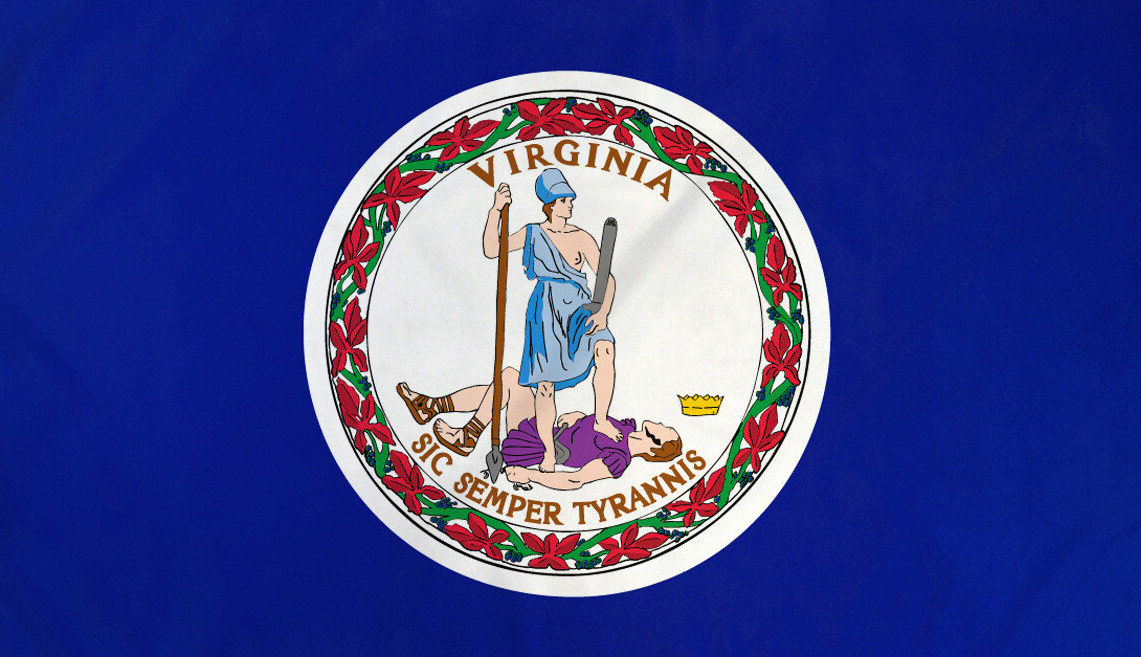
The seal of Virginia is the official symbolic representation of the Commonwealth of Virginia, a U.S. state. The state flag of Virginia consists of the obverse of the seal against a blue background. A state flag was first adopted at the beginning of the American Civil War in April 1861, readopted in 1912, and standardized by the General Assembly in February 1950. The standing allegorical female figure of virtue is shown having vanquished tyranny, symbolized by a fallen king at her feet. She has an exposed breast in the manner of classical depictions of Amazons. The motto shown on the seal, Sic semper tyrannis, means "Thus always to tyrants."
It is one of six U.S. state flags (along with Florida, New York, New Jersey, Wyoming, and Idaho) with a depiction of a woman, and the only state flag in the U.S. depicting nudity.
The flag may be decorated with a white fringe along the fly edge; this is usually done when the flag is displayed indoors
Shenandoah Valley

The Shenandoah Valley is a geographic valley and cultural region of western Virginia and the eastern panhandle of West Virginia in the United States. The Valley is bounded to the east by the Blue Ridge Mountains, to the west by the eastern front of the Ridge-and-Valley Appalachians (excluding Massanutten Mountain), to the north by the Potomac River, to the south by the James River, and to the Southwest by the New River Valley.
The cultural region covers a larger area that includes all of the Valley plus the Virginia Highlands to the west and the Roanoke Valley to the south. It is physiographically located within the Ridge and Valley Province and is a portion of the Great Appalachian Valley.
John Rolfe

John Rolfe (c. 1585 – March 1622) was an English explorer, tobacco farmer and merchant. He was the husband of Pocahontas and the first settler in the colony of Virginia to successfully cultivate a tobacco crop for export.
He played a crucial role in the Virginia Colony's early economy by introducing a sweeter strain of tobacco from Trinidad, which became a profitable cash crop. Rolfe married Pocahontas, daughter of Native American leader Powhatan, and they had a son named Thomas. Rolfe and Pocahontas traveled to England in 1616 to promote colonization and investment in Virginia.
After Pocahontas died, Rolfe returned to Virginia and continued working with tobacco. The tobacco strain cultivated by Rolfe laid the foundation for Virginia's thriving tobacco industry.
George Washington

George Washington (February 22, 1732 – December 14, 1799) was a Founding Father and the first president of the United States, serving from 1789 to 1797. As commander of the Continental Army, Washington led Patriot forces to victory in the American Revolutionary War against the British Empire. He is commonly known as the Father of His Country for his role in bringing about American independence.
Born in the Colony of Virginia, Washington became the commander of the Virginia Regiment during the French and Indian War from 1754 to 1763. He was later elected to the Virginia House of Burgesses, and opposed the oppression of the American colonists by the British Crown. When the American Revolutionary War against the British began in 1775, Washington was appointed commander-in-chief of the Continental Army. He directed a poorly organized and equipped force against disciplined British troops.
Washington and his army achieved an early victory at the Siege of Boston in March 1776 but were forced to retreat from New York City in November. Washington crossed the Delaware River and won the battles of Trenton in late 1776 and of Princeton in early 1777, then lost the battles of Brandywine and Germantown later that year. He faced criticism of his command, low troop morale, and a lack of provisions for his forces as the war continued. Ultimately Washington led a combined French and American force to a decisive victory over the British at Yorktown in 1781. In the resulting Treaty of Paris in 1783, the British acknowledged the sovereign independence of the United States. Washington then served as president of the Constitutional Convention in 1787, which drafted the current Constitution of the United States.
Washington was unanimously elected the first U.S. president by the Electoral College in 1788 and 1792. He established a strong, well-financed national government while remaining impartial in the fierce rivalry that emerged within his cabinet between Thomas Jefferson and Alexander Hamilton.
John Henry

John Henry is an American folk hero. A black American freedman, he is said to have worked as a "steel-driving man"—a man tasked with hammering a steel drill (such as a star drill or similar) into a rock to make holes for explosives to blast the rock in constructing a railroad tunnel.
The story of John Henry is told in a classic blues folk song about his duel against a drilling machine, which exists in many versions, and has been the subject of numerous stories, plays, books, and novels.
According to legend, John Henry's prowess as a steel driver was measured in a race against a steam-powered rock drill, a race that he won only to die in victory with a hammer in hand as his heart gave out from stress. Various locations, including Big Bend Tunnel in West Virginia, Lewis Tunnel in Virginia, and Coosa Mountain Tunnel in Alabama, have been suggested as the site of the contest.
Daniel Boone

Daniel Boone (November 2 [O.S. October 22] 1734 – September 26, 1820) was an American pioneer and frontiersman whose adventures made him one of the first folk heroes of the United States. He became famous for his exploration and settlement of Kentucky, which was then beyond the western borders of the Thirteen Colonies. In 1775, under commission from Judge Richard Henderson's Transylvania Company, Boone blazed the Wilderness Road through the Cumberland Gap and into Kentucky in the face of resistance from nearby Indian tribes. He founded Boonesborough, one of the first English-speaking settlements west of the Appalachian Mountains. By the end of the 18th century, more than 200,000 people had entered Kentucky by following the route marked by Boone.
He served as a militia officer during the Revolutionary War (1775–1783), which in Kentucky was fought primarily between American settlers and British-allied Indians. In 1778, Boone was captured by the Shawnee and was, according to legend, adopted by the Shawnee Chief and given the name "Sheltowee", or Big Turtle. After months of living with the Shawnee, Boone escaped.
He was elected to the first of his three terms in the Virginia General Assembly during the war and fought in the Battle of Blue Licks in 1782, one of the last battles of the American Revolution. He worked as a surveyor and merchant after the war, but went deep into debt as a Kentucky land speculator. He resettled in Missouri in 1799, where he spent most of the last two decades of his life, frustrated with legal problems resulting from his land claims.
Wood Booger

The Wood Booger is a Bigfoot-like creature said to roam the forests of southwest Virginia. The name "Wood Booger" was given to the creature because it was often rumored to carry off young children like the boogey man. This cryptid was featured in the Animal Planet TV show Finding Bigfoot episode Virginia is for Bigfoot Lovers. There have been a particularly large amount of sightings outside the town of Saltville, Virginia.
Since this visit, the city of Norton, VA has many attractions named after the Wood Booger. This city has also been named as a sanctuary for the Wood Booger. Since 2014, an annual WoodBooger festival is held where visitors can go on guided tours to search for the creature. A statue of the Wood Booger is located at the Flag Rock Overlook.
The Wood Booger Bar and Grill is named after the creature and many local businesses sell merchandise of the Wood Booger. In September, a geocaching event named the WoodBooger Geo Trail is held in the Flag Rock Recreation Area.
Mothman

In American folklore, Mothman is the name given to a humanoid creature that was reportedly seen around Point Pleasant, West Virginia, from November 15, 1966, to December 15, 1967. Despite its name, the original sightings of the creature described avian features. The first newspaper report was published in the Point Pleasant Register, dated November 16, 1966, titled "Couples See Man-Sized Bird ... Creature ... Something".
The national press soon picked up the reports and helped spread the story across the United States. The source of the legend is believed to have originated from sightings of out-of-migration sandhill cranes or herons.
The creature was introduced to a wider audience by Gray Barker in 1970,and was later popularized by John Keel in his 1975 book The Mothman Prophecies, claiming that there were paranormal events related to the sightings, and a connection to the collapse of the Silver Bridge.
The book was later adapted into a 2002 film starring Richard Gere.
An annual festival in Point Pleasant is devoted to the Mothman legend.
Chessie

Chessie is a large serpent-like animal that allegedly lives in the Chesapeake Bay. Over the years there have been many sightings of a serpent-like creature without any flippers or horns on its body. Most sightings describe it as a long, snake-like creature, from 25 feet (7.6 m) to 40 feet (12 m) long.
It is said to swim using its body as a sine curve moving through the water. There are no limbs or crests, like most snakes. There was a cluster of sightings in 1977 and more in the mid-1980s.


Comments