


Caernarfonshire

Updated: Feb 24
Where is Caernarfonshire?

In our episode about Caernarfonshire, we talked about lots of interesting places and things, so here are some pictures and links to find out more!
Yr Wyddfa and Eryri National Park
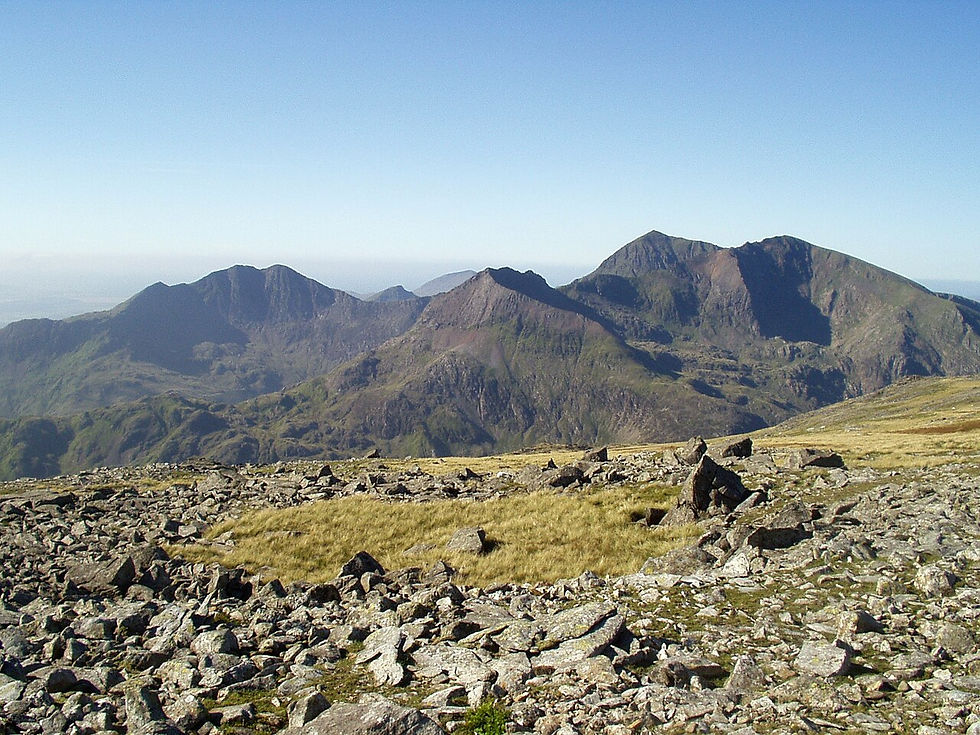

Standing at over 3,000 feet, Yr Wyddfa is the highest mountain in the National Park and undoubtedly Eryri’s most popular summit.
Yr Wyddfa is an iconic mountain known throughout the world, an inherent part of a rich and vibrant community and home to many Welsh mountain farms.
Every year, Eryri National Park’s astonishing landscapes attract millions of visitors. The National Park is home to Wales’ highest peak and Wales’ largest natural lake—two of Eryri’s most popular attractions.
Dinas Emrys

Dinas Emrys (Welsh for 'Emrys's city') is a rocky and wooded hillock near Beddgelert in Gwynedd, north-west Wales. Rising some 76 m (250 ft) above the floor of the Glaslyn river valley, it overlooks the southern end of Llyn Dinas in Snowdonia.
Little remains of the Iron Age hillfort or castle structures that once stood here, save its stone ramparts and the base of a keep. Some believe the castle was erected by Llewelyn the Last to guard the road to the mountain pass of Snowdon.
Caernarfon Castle

Castell Caernarfon is recognised around the world as one of the greatest buildings of the Middle Ages.
This fortress-palace on the banks of the River Seiont is grouped with Edward I’s other castles at Conwy, Beaumaris and Harlech as a World Heritage Site. But for sheer scale and architectural drama Caernarfon stands alone.
Here Edward and his military architect Master James of St George erected a castle, town walls and a quay all at the same time. This gigantic building project eventually took 47 years and cost a staggering £25,000.
The castle was born out of bitter war with Welsh princes. So of course its immense curtain walls and daunting King’s Gate were designed to withstand assault. But the polygonal towers, eagle statues and multi-coloured masonry sent a more subtle message.
These echoed imperial Roman architecture, especially the walls of Constantinople. They also recalled the Welsh myth of Macsen Wledig, who dreamed of a great fort at the mouth of a river – ‘the fairest that man ever saw’.
So Caernarfon is a castle of dreams. A legend brought to life. Even after 700 years it still stirs the imagination like no other Welsh castle.
Conwy Castle

Thanks to restored spiral staircases in its great towers you can walk a complete circuit around the battlements of Castell Conwy. We highly recommend it. This is one of the most magnificent medieval fortresses in Europe.
In the distance rise the craggy mountains of Eryri (Snowdonia) and spread out below you are the harbour and narrow streets of Conwy – still protected by an unbroken 1,400-yard (1.3km) ring of town walls.
It’s enough to take the breath away. Especially when you consider that King Edward I and his architect Master James of St George built both castle and walls in a barely believable four years between 1283 and 1287.
Conwy takes its place alongside Edward’s other great castles at Beaumaris, Harlech and Caernarfon as a World Heritage Site.
This famous fortress is exceptionally well preserved. It contains the most intact set of medieval royal apartments in Wales. The high curtain wall and eight lofty towers rise almost as impressively as when they were built more than 700 years ago.
Beddgelert

Beddgelert is a village and community in the Snowdonia area of Gwynedd, Wales. The population of the community taken at the 2021 census was 460 (rounded to the nearest 10).This includes Nantmor and Nant Gwynant. Despite the village being reputably named after the legendary hound Gelert, it's actually named after Saint Gelert, an early leader in Celtic Christianity.
The folk tale of the faithful hound "Gelert" is often associated with the village. But the raised mound in the village called "Gelert's Grave" was built by David Pritchard, a late 18th-century landlord of the Goat Hotel. He created it in order to encourage visitors and it still remains popular attraction. Similar legends can be found in other parts of Europe and Asia.
The village is actually named after an early Celtic Christian missionary and leader named Saint Gelert (Celert or Cilert) who settled here early in the 8th century. The earliest record of the name Beddgelert is in a 1258 document where it is recorded as "Bekelert". In a document of 1269 it is recorded as "Bedkelerd". The current name of the village is often rendered "Begél" in the local Welsh dialect.
Llyn Ogwen

The valley of Ogwen is one of the National Park’s most breathtaking backdrops. The valley is a great base for exploring both the Carneddau and Glyderau mountain ranges and is home to Cwm Idwal—a jaw-dropping glacial valley famous for its geology.
Rhinog Fawr

Rhinog Fawr is a mountain in Snowdonia, North Wales and forms part of the Rhinogydd range. It is the third highest summit of the Rhinogydd, losing out to Y Llethr and Diffwys respectively. Its smaller cousin Rhinog Fach lies to the south, separated by the pass of Bwlch Drws Ardudwy, while its other neighbour, Moel Ysgyfarnogod lies to the north.
In common with most of the range, the terrain is characterised by hard sedimentary rock covered with heather, making progress on foot difficult. At 510m, nestled in crags, lies Llyn Du, a small tarn beneath the summit. The ascent is most easily made from the north-east or north-west, via the Roman Steps pass.

Comments