


Anglesey

Where is Anglesey?

In our episode about the historic Welsh county of Anglesey we talked about lots of interesting places and things, so here are some pictures and links if you're interested in finding out more.
St Dwynwen

Saint Dwynwen (Welsh pronunciation: [ˈdʊɨnwɛn]; fl. 5th century), sometimes known as Dwyn or Donwen, is the Welsh patron saint of lovers. She is celebrated throughout Wales on 25 January.
The original tale of Dwynwen has become mixed with elements of folklore and Celtic stories, resulting in multiple versions. She is believed to have been a daughter of King Brychan Brycheiniog, who lived in the 5th century; her mother may have been Rigrawst. Dwynwen is said to have resided in Anglesey.
In one well-known version of the legend, a young man named Maelon Dafodrill falls in love with Dwynwen, but she rejects him; in another, she cannot marry him because her father has already promised her to another. Distraught, Dwynwen prays to fall out of love with Maelon. An angel appears with a potion: Maelon turns to ice. God then grants her three requests: that Maelon be released from his icy fate; that God, through Dwynwen, watch over all true lovers; and that she herself remain unmarried. As a mark of thanks, she retreats to the solitude of Ynys Llanddwyn off Anglesey, becoming a hermit until her death around AD 460 (some texts say she fled there out of fear of Maelgwn Gwynedd).
Bryn Celli Ddu
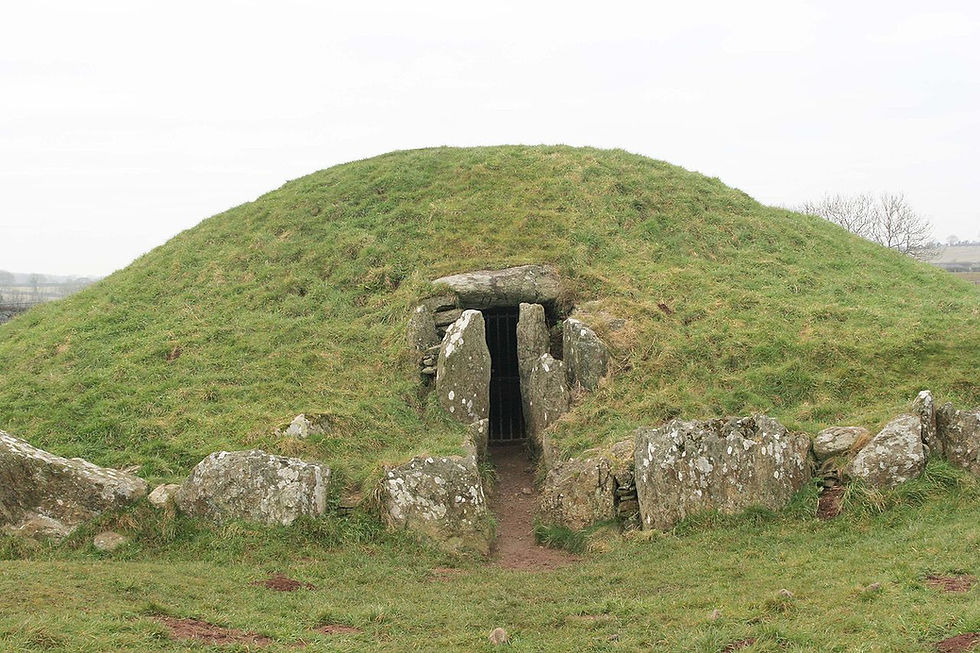
Bryn Celli Ddu (Welsh pronunciation: [ˌbrɪn kɛɬi ˈðɨː]) is a prehistoric site on the Welsh island of Anglesey located near Llanddaniel Fab. Its name means 'the mound in the dark grove'. It was archaeologically excavated between 1928 and 1929.
Visitors can get inside the mound through a stone passage to the burial chamber, and it is the centrepiece of a major Neolithic Scheduled Monument in the care of Cadw. The presence of a mysterious pillar within the burial chamber, the reproduction of the 'Pattern Stone', carved with sinuous serpentine designs, and the fact that the site was once a henge with a stone circle, and may have been used to plot the date of the summer solstice have all attracted much interest.
The Swellies

The Swellies or Swillies (Welsh: Pwll Ceris) is an area of treacherous water in the Menai Strait, Wales, most commonly referring to the stretch between the Britannia Bridge and the Menai Bridge.
It is notable for its difficulty in safely navigating its shoals and rocks due to the whirlpools and surges that are the result of the tides washing around the island of Anglesey at different speeds. There are several small islands in The Swellies, the largest of which are Church Island (Welsh: Ynys Dysilio) and Welsh: Ynys Gored Goch (Red Weir Island in English but also known as Whitebait Island).
The Welsh name (variously spelled as "Pwll Ceris", "Pwll Cerys" or "Cerys bwll"), has been in popular usage since at least the sixteenth century when it became the subject for a number of poetic works by Welsh bards. Some of these works were reprinted in The Cambro-Briton journal in 1806, including works by the notable bards Gruffudd Hiraethog and Huw Roberts Len. These works would again be republished throughout the nineteenth century, including as part of thirteen englynion on Pwll Ceris published in the journal Y Grael in 1820.
Menai Suspension Bridge

For centuries, travel to Anglesey from the mainland was often hazardous. Ferries traversed the Menai Straits at various places, but the currents are tricky and numerous boats capsized or ran aground, often with loss of life.
In 1800, Ireland joined the UK through the Act of Union. This meant that the numbers of people wishing to cross the Straits increased as politicians commuted to and from Ireland to parliament in London.
The route from London to Holyhead became an important roadway, representing a physical link between parliament and Ireland. Although well travelled, the journey was still notoriously dangerous.
In 1819, a civil engineer called Thomas Telford began working on ambitious improvements to journey between London and the port of Holyhead. Recognising the danger to travellers that crossing the Straits involved, Telford designed a groundbreaking piece of civil engineering – the Menai Bridge.
Completed on 30 January 1826, the Menai Bridge was a triumph of civil engineering – the biggest suspension bridge in the world at the time. Sixteen huge chains held up 579 feet of deck, allowing 100 feet of clear space beneath. This allowed tall sailing ships navigating the seaway to pass underneath, whilst spanning the Straits at its narrowest point.
Britannia Bridge

As rail travel became increasing popular in the mid nineteenth century, it was deemed necessary for a rail link across the Menai Strait for the convenience of MPs travelling to and from Ireland. The possibility of adding a rail line across the Menai Suspension Bridge was investigated, but found to be inappropriate. Therefore a second bridge across the Menai Strait was commissioned.
This bridge would need to be at least 100 feet above the high water level to allow tall sailing ships to move underneath the bridge. It would also need to support two train tracks across its main span. To complete such a bridge today would still be considered a difficult prospect. The challenge was handed to Robert Stephenson, son of George Stephenson, who was one of the leading railway and civil engineers of the time. His design team also included William Fairbairn and Eaton Hodgkinson.
The construction of the Britannia Bridge was started in 1846 and completed four years later in March 1850. The tubes were constructed onshore on the banks on the Menai Strait before being floated out into place and hydraulically pumped into position. At the same time Stephenson’s other tubular bridge in North Wales, the Conway Bridge, was also being constructed and their completion signalled the opening of the Chester to Holyhead railway.
Beaumaris Castle

Beaumaris on the island of Anglesey is famous as the greatest castle never built. It was the last of the royal strongholds created by Edward I in Wales – and perhaps his masterpiece.
Here Edward and his architect James of St George took full advantage of a blank canvas: the ‘beau mareys’ or ‘beautiful marsh’ beside the Menai Strait. By now they’d already constructed the great castles of Conwy, Caernarfon and Harlech. This was to be their crowning glory, the castle to end all castles.
The result was a fortress of immense size and near-perfect symmetry. No fewer than four concentric rings of formidable defences included a water-filled moat with its very own dock. The outer walls alone bristled with 300 arrow loops.
But lack of money and trouble brewing in Scotland meant building work had petered out by the 1320s. The south gatehouse and the six great towers in the inner ward never reached their intended height. The Llanfaes gate was barely started before being abandoned.
So the distinctive squat shape of Beaumaris tells of a dream that never quite came true. Still it takes its rightful place on the global stage as part of the Castles and Town Walls of King Edward in Gwynedd World Heritage Site.
Aberlleiniog Castle

Like so many sites on Anglesey, Aberlleiniog is a hidden gem. It combines fascinating history with natural beauty - without any of the crowds.
Aberlleiniog Castle is a little-known Scheduled Ancient Monument, situated near Penmon.
It nestles at the heart of a peaceful woodland nature reserve, close to the shores of the beautiful Menai Strait, within the Anglesey Area of Outstanding Natural Beauty (AONB).
The castle is owned by Menter Môn, Anglesey's enterprise and rural development agency. It is managed by a steering group of local representatives. The management priorities for the site include its historical and cultural interest, nature conservation and public access.
Aberlleiniog Castle's natural surroundings and unique history set it apart from any other ancient monument.
Its captivating story abounds with colourful characters, including Welsh princes, Norman overlords, Viking raiders, traitors, pirates, Civil War commanders, wealthy estate owners and Georgian naturalists. It has something to capture everyone's imagination.
Aberlleiniog truly is a 'secret' castle, with many secrets still to be uncovered!
Castell Bryn Gwyn
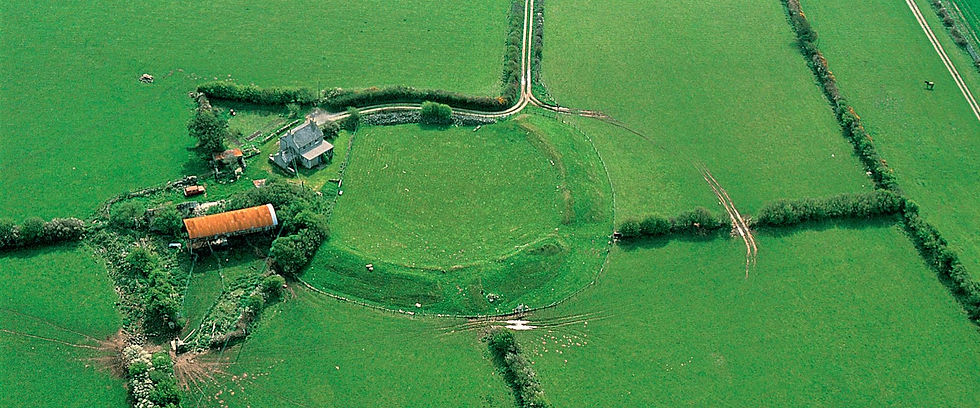
Though all that remains of this Neolithic (New Stone Age) settlement is a single bank, excavations have revealed a site with a particularly long history. Its origins stretch back to a circular enclosure featuring a bank and external ditch built in the late Neolithic era or early Bronze Age. Originally thought to be a ceremonial henge monument, finds of pottery, post holes and flint and bronze tools are in fact those of a settlement.
The locals must have liked the place. Castell Bryngwyn was used far beyond the Neolithic period, with archaeological finds suggesting it was still inhabited as late as 1st-century Roman times.
Plas Newydd

On the island of Ynys Môn (Anglesey), Plas Newydd is a Grade I-listed house and garden on the banks of the Menai Strait.
With the mountains of Eryri (Snowdonia) as a dramatic backdrop, enjoy the 40 acres of peaceful garden and 129 acres of woodland and parkland.
There is plenty of space to relax and explore, with gently sloping lawns, towering trees, and beautiful borders to discover, while the comfortable house contains an unusual mix of military history, theatre, and art.
Llyn Cerrig Bach Hoard

This summer, an assemblage of Iron Age metalwork went on display at Oriel Ynys Môn, the Isle of Anglesey’s principal museum and gallery, for the first time since its discovery 70 years ago.
Shortly to return to its home at the National Museum, Cardiff, the find consists of a mix of animal bones and the remains of some 180 separate items of metalwork, including bronze swords, spears and shield boss, bronze horns, cauldrons, slave-gang chains, iron ‘currency bars’, and chariot parts.
Because it was found over a period of weeks during 1942 and 1943, in the midst of the Second World War, the find made little impact at the time, but over the intervening period it has come to be recognised as a discovery of immense importance for understanding Iron Age Wales and its people.

Comments