


Welcome to Wales

For Series 7, we're leaving our familiar stamping ground of England's 39 historic counties, and turning our attentions to the 13 historic counties of Wales! Before we embarked, we thought it was worth covering a very brief history of Wales prior to the Norman Conquest, both to get ourselves up to speed and to give our listeners some context.
Episode 0 of the series tracks through the story of how the country of Wales actually became 'Wales' - from the nation's very first settlers who wandered west through England through to the Stone Age tradition of cromlech building, the Bronze Age, and, in due course, the Iron Age, too.
Along the way, the nascent country of Wales developed its own place within Celtic culture, apart from its immediate neighbours, yet connected by ancient trade routes, including by sea. With more hill forts per square mile than any other British nation, even before the Romans came along things in Wales were feisty.
Yet, once the Romans came, much like in neighbouring England, things changed forever. Across almost four centuries, the Welsh landscape itself was reshaped by Rome, all before maintaining such large armies in 'Britain' became unaffordable.
As Rome retreated, Christianity arrived, and with it a tantalizing time: the development of Anglo Saxon 'England' on one side of Offa's Dyke, and, on the other, one that called itself 'Cymry' - 'the collective' or 'fellow countrymen.'
While the Angles called them the 'Wealas' - 'the foreigners...'
The historic counties of Wales
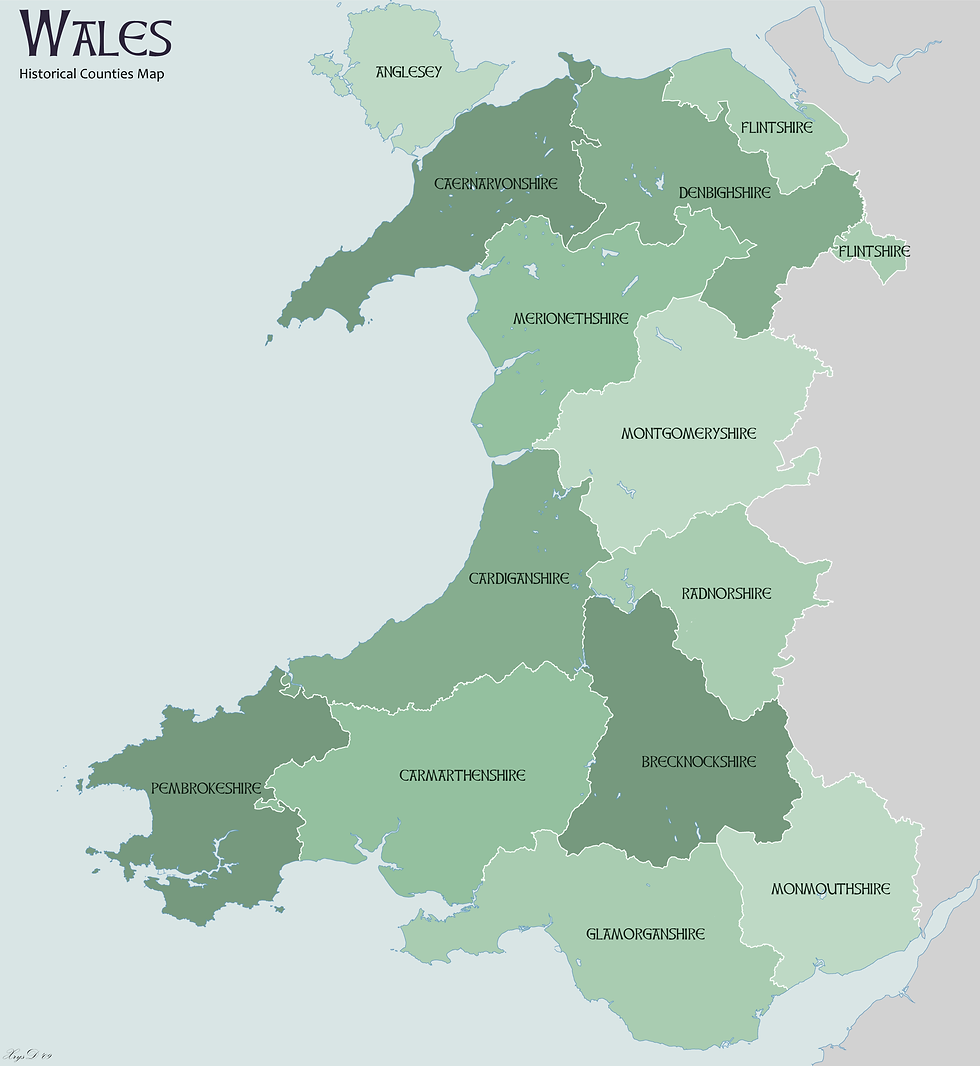
The historic counties of Wales (Welsh: siroedd hynafol) were the thirteen sub-divisions used in Wales from 1535 up to their abolition in 1974 when they were replaced by eight larger administrative counties (which in turn were replaced with the current twenty-two).
They were used for various functions for several hundred years, with some dating to 1282, but for administrative purposes have been superseded by contemporary sub-national divisions, some of which bear some limited similarity to the historic entities in name and extent. They are alternatively known as ancient counties.
Saint David

St David was born in the year 500, the grandson of Ceredig ap Cunedda, King of Ceredigion. According to legend, his mother St Non gave birth to him on a Pembrokeshire clifftop during a fierce storm. The spot is marked by the ruins of Non’s Chapel, and a nearby holy well is said to have healing powers.
St David became a renowned preacher, founding monastic settlements and churches in Wales, Brittany and southwest England – including, possibly, the abbey at Glastonbury. St David reputedly made a pilgrimage to Jerusalem, from which he brought back a stone that now sits in an altar at St Davids Cathedral, built on the site of his original monastery.
The most famous miracle associated with St David took place when he was preaching to a large crowd in Llanddewi Brefi. When people at the back complained that they could not hear him, the ground on which he stood rose up to form a hill. A white dove, sent by God, settled on his shoulder.
St David died on 1 March – St David’s Day - in 589. He was buried at the site of St Davids Cathedral, where his shrine was a popular place of pilgrimage throughout the Middle Ages. His last words to his followers came from a sermon he gave on the previous Sunday: ‘Be joyful, keep the faith, and do the little things that you have heard and seen me do.’ The phrase ‘Gwnewch y pethau bychain mewn bywyd’ - ‘Do the little things in life’ - is still a well-known maxim in Wales.
Territories of the ancient tribes of Wales

The Roman geographer Ptolemy left us with a generalised but valuable description of the native tribes of Wales. For the first time in the prehistory of Wales we have names for some of the people in the landscape.
While many authors and academics have offered differing views on precise division of territory, it is generally agreed that Wales was occupied by five or six main tribes at the time of the Roman conquest; the Demetae in the south-west (approximating Pembrokeshire and Carmarthenshire), the Silures in the south and east (approximately modern Glamorgan and parts of Brecknock to the Wye), the Ordovices in the mid- and north-west of Wales (broadly Anglesey, Gwynedd and much of Powys, and the Deceangli in the north-east (modern Denbighshire and the Clwydian range). The Cornovii occupied the fringe of north-east Wales, the Borderlands and the Cheshire and Shropshire Plains.
Neanderthal life in Wales

Humans have lived in Wales for over a quarter of a million years, first by the Neanderthals and then by modern humans. Evidence for the first human occupation of Wales can be found in caves around the country.
The 'Palaeolithic' or 'Early Stone Age' period is the time popularly known as the 'Ice Age'. It saw very cold periods (known as glacials) when ice covered all of Wales, and warm periods (interglacials), like the one in which we live today. It is against this backdrop of changing climate that our earliest ancestors evolved from their African origins, migrated across Europe and Asia, and developed into modern humans.
The first evidence we have for humans in Wales comes from the site of Pontnewydd Cave (Denbighshire). Here, excavations have identified the remains of an early form of Neanderthal, that lived around 230,000 years ago.
Paviland Cave, or 'Goat's Hole'

Goat's Hole or Paviland Cave is situated at the base of an almost vertical south-west facing cliff at the end of a dry valley known as Fox Hole Slade. The opening leads to a 21m long passage ending in a chamber 3.6m high beyond which is a funnel shaped chimney. The cave is floored largely with bare rock, any sediments remaining after the excavations having been resorted or removed by wave action.
Situated about 9m above sea level the cave can be approached at low tide or by a dangerous climb along the base of the cliff. The many excavations have yielded a large amount of artifacts from animal bones of the later palaeolithic period to two coins of A.D. 300. The most famous discovery known as "The Red Lady of Paviland" - a collection of human bones which have been dated to about 24,000 years old turned out to be the bones of a male. This suggests that the cave was used on a casual basis over a long period of time.
Ffynnon Beuno and Cae Gwyn Caves

Fynnon Beuno and Cae Gwyn Caves are two scheduled monuments, in Denbighshire, Wales, which are also designated a Site of Special Scientific Interest (SSSI).
The site has two caves, with entrances close to each other high on a valley side, above the Vale of Clwyd. They were first excavated in 1883–5. Human tools have been found on the site dating back to around 36,000 BC, and a mammoth bone has been dated back to 16,000 BC.
These very early discoveries were significant in providing one of the first direct associations between stone tools of Paleolithic people and the bones of extinct pre-ice age animals such as mammoth and woolly rhinoceros.
The Mabinogion

The Mabinogion is a collection of the earliest Welsh prose stories, compiled in Middle Welsh in the 12th–13th centuries from earlier oral traditions. There are two main source manuscripts, created c. 1350–1410, as well as a few earlier fragments. Often included in the broader mythologies described as the Matter of Britain, the Mabinogion consists of eleven stories of widely different types, offering drama, philosophy, romance, tragedy, fantasy and humour.
Strictly speaking, the Four Branches of the Mabinogi are the main sequence of related tales, but seven others include a classic hero quest, "Culhwch and Olwen"; a historic legend, complete with glimpses of a far off age, in "Lludd and Llefelys"; and other tales portraying a very different King Arthur from the later popular versions.
The stories were created and amended by various narrators over a very long period of time, and scholars beginning from the 18th century predominantly viewed the tales as fragmentary pre-Christian Celtic mythology,or folklore.
Since the 1970s, an investigation of the common plot structures, characterisation, and language styles, especially in the Four Branches of the Mabinogi, has led to an understanding of the integrity of the tales, and they are now seen as a sophisticated narrative tradition, both oral and written, with ancestral construction from oral storytelling,and overlay from Anglo-French influences
Cromlechi

Similarly to the inhabitants of Spain, Brittany and other parts of Britain, in 3500 BC the Welsh settlers began to construct dwelling places from large, interlocking stones which were made in such a way as to remain stable without the use of mortar or cement.
Today, these types of structure are more commonly known as megalithic, from the Ancient Greek words megas meaning ‘great’ and lithos meaning ‘stone’. However, in the Brythonic language – the shared Celtic language which was the forefather to the Welsh, Cornish, Breton, Cumbric and Continental Celtic languages of Europe – the dwellings were known as Cromlech or Cromlechi which originated from the words crom meaning “bent” and llech meaning “flagstone”.
Around 150 cromlechi can still be seen in Wales today and interestingly they are spread across more of the western side of the territory, suggesting an influence from neighbours across the sea rather than neighbours to the east in England.
The Llanllyfni Lunulae

This stunning decorated object is one of the earliest gold artefacts to have been found in Wales and dates to the beginning of the Bronze Age (2400-2000BC).
It was found a few miles from Llanllyfni (Gwynedd) on Llecheiddior-uchaf Farm near Dolbenmaen in about 1869. A farmer noticed what he took to be a yellow laurel leaf sticking out of some peat. Later, unsatisfied with this explanation, he returned to the site and uncovered the crescent-shaped object of gold.
Known as a 'lunula' after its crescent-shape (luna = moon in Latin), objects like this have been found in Scotland, Cornwall, and north-west France, with as many as 90 being discovered in Ireland.
The Moel Siabod Shield

The Moel Hebog shield (Welsh: Tarian Moel Hebog) or Moel Siabod shield is a large copper-alloy Yetholm-type shield from Bronze Age Britain, found in North Wales in 1784, and now held in storage at the British Museum in London. It dates from 1300–1000 BC.
The Nannau Bucket

During the late Bronze Age, metalworkers mastered the art of making buckets and cauldrons from hammered sheets of bronze, fastened together with rivets. The Arthog Bucket is one of the earliest known in Britain. It was made in south-eastern Europe and brought to Wales, before being buried in marshy ground in the Mawddach Estuary, probably during a ritual ceremony to the Gods.


Comments