


Cardiganshire

Updated: Oct 2, 2025
Where is Cardiganshire?
In our first episode about the 13 historic counties of Wales, we mentioned lots of interesting places and things in Cardiganshire (modern Ceredigion) so here are some pictures and some information if you're interested in finding out more.
Saint Carantoc

Saint Carantoc (Welsh: Carannog; Irish: Cairnech; Breton: Karanteg; Latin: Carantocus), also anglicized as Carantock, Carannog and by other spellings, was a 6th-century abbot, confessor, and saint in Wales and the West Country. He is credited with founding Llangrannog, Ceredigion, Wales and St Carantoc's Church, Crantock.
His name is listed amongst the Cornish Saints. Carantoc's is one of five insular saints' lives and two Breton ones that mention Arthur in contexts that may be independent of Geoffrey of Monmouth's Historia Regum Britanniae. He is venerated by the Eastern Orthodox Church and Roman Catholic Church.
Cardigan Bay

Cardigan Bay is the largest bay on the Welsh coast. Cardigan Bay's wide sweep is made up of several smaller bays between the headlands of Pembrokeshire and the Llŷn Peninsula. As you travel along the Ceredigion coast, especially along the Ceredigion Coast Path, the whole of Cardigan Bay extends before you, with views as far as Snowdonia and Bardsey Island.
Ceredigion's coast is rich in wildlife and much of the coast is protected as Special Areas of Conservation. Home to the biggest population in Europe of bottlenose dolphins, the Cardigan Bay Special Area of Conservation (SAC) extends along almost 20 kilometres of coast and protects wildlife in 1000 square kilometres of the Irish Sea.
Cambrian Mountains
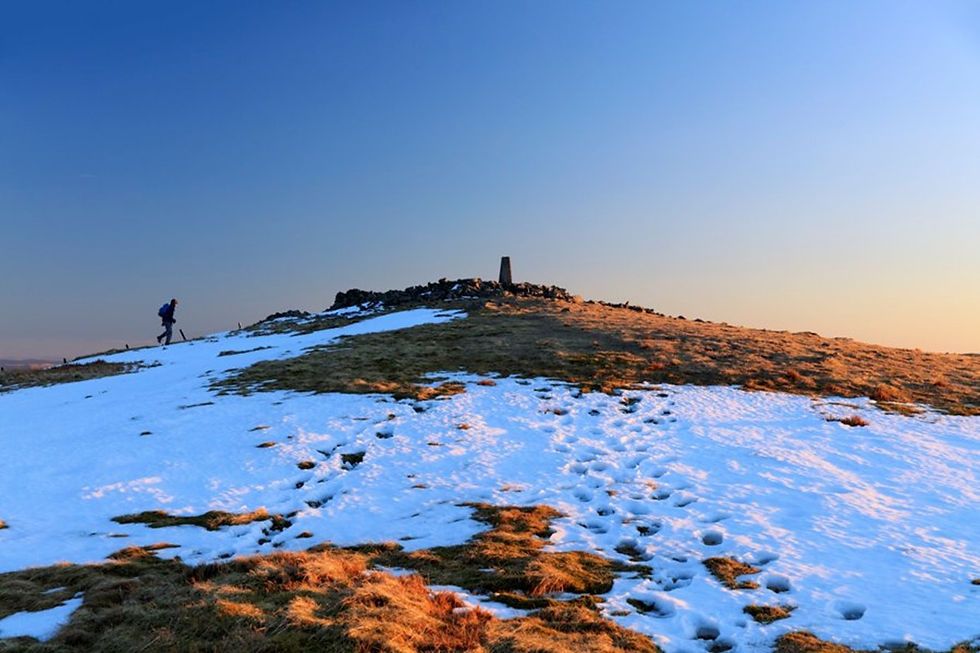
The Cambrian Mountains are one of the few remote wilderness areas left in Southern Britain. The main settlements lie on the edges of a wild open moorland and although there are only few roads across the mountains they are acknowledged as some of the most scenic routes in Britain.
The Cambrian Mountains may have few distinct peaks, but climb Pumlumon - to the highest of its five summits ('five' in Welsh is 'pump') - for unbroken views as far as the mountains of Snowdonia and Llyn Peninsula to the north, and the Brecon Beacons and Pembrokeshire to the south. The remotest part of the mountains is the area called Elenydd - an area of internationally important blanket bog blanket and breeding site for the red kite, merlin and peregrine falcon.
Aberystwyth Castle

Long before the Normans began their castle-building program, Iron Age settlers used the hilltop called Pen Dinas to build a huge fortification, which still dominates the skyline as you approach Aberystwyth from the south and reminds us of the skills of its ancient builders.
The first Norman castle was a ringwork affair castle, built in the early 12th Century. Inevitably, the earth and timber defences proved too vulnerable and a new site was chosen for a castle in Aberystwyth itself. This time it was the Welsh, led by Llywelyn the Great who built the castle and it changed hands several times before finally became useless against new weapons. The last castle built at Aberystwyth once ranked among the greatest in Wales but today, lies entirely ruined and offering only a faint image of its once impressive past.
How then did Aberystwyth Castle become such a ruin? Amazingly, as early as the 14th century, the concentric fortress began to decay. By 1343, large portions of the main gateway and drawbridges, and the outer bailey were falling down. The closeness of the castle to the pounding sea causing much of the decay.
In 1404, Owain Glyndwr seized the crumbling fortress. Within a few years the English regained possession but after 1408, Aberystwyth Castle lost its strategic value to the monarchy, and only minor repairs were attempted. During the Civil War, the castle became a victim of Oliver Cromwell’s ruthless policy of slighting because the garrison sided with the king, Charles I. Most of the castle stone was pilfered by locals to build their homes.
Cardigan Castle

Cardigan Castle (Welsh: Castell Aberteifi) is a castle overlooking the River Teifi in Cardigan, Ceredigion, Wales. It is a Grade I listed building. The castle dates from the late 11th-century, though was rebuilt in 1244. Castle Green House was built inside the castle walls in the early 1800s.
After falling into disrepair the castle was restored in the early 2000s and opened to the public in 2015. It is owned by Ceredigion County Council and now includes a heritage centre and open-air concert facilities. The castle's gardens are listed on the Cadw/ICOMOS Register of Parks and Gardens of Special Historic Interest in Wales.
Cantre'r Gwaelod

According to the legend, Cantre’r Gwaelod was the rich and fertile ‘lowland hundred’ and sixteen cities governed by Gwyddno Garanhir, whose palace, Caer Wyddno, was reputedly near Aberystwyth. The land stretched across what is today the open sea of Cardigan Bay, and lay below sea level, protected by sea walls.
The guardian of the sea defences was Seithennyn, a friend of the king charged with the all-important role of shutting the sea gates every night. One night Seithennyn, who liked his drink, was at a feast in the king's palace, and forgot to shut the sea gates. It was a stormy night and the high spring tides broke through, quickly flooding Cantre’r Gwaelod, and forcing its people to flee to the hills.
Walk on Borth and Ynyslas beach and find the peat and tree stumps of the sunken forest of Cantre'r Gwaelod. It's probably best seen in winter after the strong tides scour away the sand.
Strata Florida Abbey

The Cistercian abbey of Strata Florida (‘Vale of Flowers’ in Latin) has stood on lush meadows beside the banks of the river Teifi since 1184.
It was established by white-robed Cistercian monks as part of a movement that spread like a tidal wave across the whole of western Europe in the early Middle Ages. Soon it became the most famous church in Wales after St Davids – a place of pilgrimage and a linchpin of Welsh culture.
There are unmistakable echoes of greatness among the ruins. The best preserved and most famous feature of Strata Florida is the richly decorated west doorway into the church, offering a view down the nave to where the high altar once stood.
You can still see some of the incredible decorated tiles that would have covered the floors of the church. Griffins, birds and fleurs-de-lis surround the enigmatic ‘Man with the Mirror’. This 14th-century figure dressed in a doublet and close-fitting hood is reckoned to be a symbol of vanity.
Strata Florida, or Ystrad Fflur as local people know it, is the final resting place for generations of medieval Welsh princes. The great medieval poet Dafydd ap Gwilym is said to be buried under a yew in the churchyard. There is a memorial to him in the north transept of the church. No wonder it’s been called ‘the Westminster Abbey of Wales’.
The Nanteos Cup

This fragile piece of wood is all that remains of an ancient mazer bowl commonly known as the Nanteos Cup.
The exact origin of the Cup is a mystery, but it seems that the relic came into the possession of the Powell family of Nanteos from Strata Florida Abbey during the Dissolution of the Monasteries.
According to one tradition, the Nanteos Cup is the Holy Grail, the Cup from which Christ and his disciples drank at the Last Supper. Since the 19th Century it has been claimed that the Cup possesses a supernatural power to heal. The Cup would be lent to the unwell in exchange for a valuable deposit such as a gold watch or coin, as to ensure its safe return to Nanteos.
The Devil's Bridge, Pontarfynach

Devil's Bridge has been a tourist attraction for centuries. The celebrated English author George Borrow wrote Wild Wales (1854), which includes a lively, humorous account of his visit to Pontarfynach and a 17th century inn where Borrow reputedly stayed during his visit, is located nearby.
Devils Bridge is internationally famous for its waterfalls and narrow gauge Steam Railway. The village is situated at the head of the Rheidol Valley amidst the Pumlumon massif in the heart of the Cambrian Mountains. Nearby Pen Pumlumon Fawr, at 752 metres (2,467ft) is the highest peak in the Cambrian Mountains Range and the area is well-known for its forest and mountain walks.
Two rushing streams, the Mynach and Rheidol, descend dramatically into a gorge below the village where over time three different bridges have been built, one on top of the other. Visitors can enjoy several footpaths and walks to view the bridges and waterfalls. The bridge is at a point where the River Mynach drops 90 metres (300 ft) in 5 steps down a steep and narrow ravine before it meets the River Rheidol. The set of stone steps leading down to the lowest bridge at the waterfall are known as Jacob's Ladder.
Devil's Bridge has its own railway station on the historic narrow gauge Vale of Rheidol Railway, which opened between Aberystwyth and Devil's Bridge in 1902.
According to the local legend, the original bridge was built by the Devil, as it was too difficult for mortals to build. The agreement stipulated that the Devil would build the bridge in return for the soul of the first life to cross the bridge.
The Devil built the bridge but was tricked by an old woman who threw bread onto the bridge. Her dog crossed the bridge for the bread, thus becoming the first life to cross the new bridge.
Carreg Bica

At Llangrannog there is a rocky outcrop on the beach, called Carreg Bica. According to legend, Bica was a local giant who suffered from toothache. One version of the legend tells how he spat the offending tooth out in anger, and it fell into the sand on Llangrannog beach. Imagine the size of Bica when you see the weathered rock between the two Llangrannog beaches of today.
Another version of the tale explains the nearby Ynys Lochtyn. As a reward for helping Bica to remove his bad tooth, Lochtyn demanded an island for himself. Bica created an island for Lochtyn by running his finger along the land on the horizon. The peninsula just north of Llangrannog, with a tiny island at its end is known as Ynys Lochtyn.
Nanteos House

Nanteos (Welsh: Plas Nanteos, Nanteos Mansion) is an 18th-century former country house in Llanbadarn-y-Creuddyn, near Aberystwyth, Ceredigion, Wales. A Grade I listed building, it is now a country house hotel. The gardens and parkland surrounding the mansion are listed on the Cadw/ICOMOS Register of Parks and Gardens of Special Historic Interest in Wales.
The current building was constructed between 1738 and 1757 for the Powell family, with the Shrewsbury architect Edward Haycock Sr. designing the stable block in the 1830s, and William Ritson Coultart designing the east wing and rear offices in 1841. The family occupied the house for some 200 years up until the last of the Powells, Margaret Powell, who died in 1951. At its peak the Nanteos estate comprised some 31,000 acres in 1800, covering most of what is today Aberystwyth, and was the major employer of the county. The name derives from the Welsh for "brook" (nant) and "nightingale" (eos).
The house was once the home of the Nanteos Cup, a medieval mazer drinking bowl that has been attributed with a supernatural ability to heal those who drink from it; it was traditionally believed to be fashioned from a piece of the True Cross. A 1905 pamphlet declared it to be the Holy Grail.
Bedd Taliesin

About eight miles north of Aberystwyth is a chambered cairn known as Bedd Taliesin.
From Folk-lore of the West and Mid-Wales:
According to a local tradition, Taliesin, Chief Bard of the Island of Britain was buried on this spot. The grave, which is composed of stones, is in the centre of a large heap of earth or mound surrounded by stone circles, and some generations ago bones, and even a human skull, were found in it, which probably were the remains of the great ancient poet.
There is a superstition respecting Bedd Taliesin that should anyone sleep in it for one night, he would the next day become either a poet or an idiot.
Taliesin’s Grave is in the Parish of Llanfihangel genau’r Glyn, and in the adjoining parish of Llancynfelin there is a village bearing the name of Taliesin; and, according to the ‘Mabinogion,’ the great poet was born somewhere between the Dyvi and Aberystwyth. The people of North Cardiganshire believe to this day that Taliesin was both born and buried in their district.

Comments